9 Best Cross-Stitch Kits for Beginners (2026 Buyer's Guide)
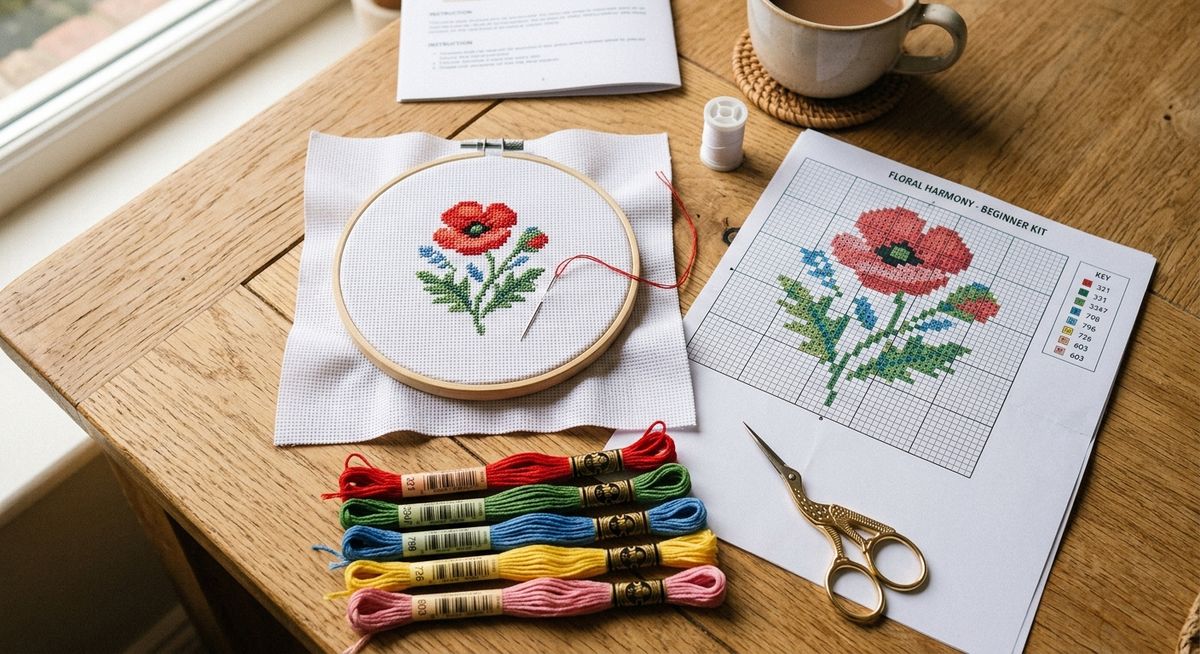
Starting cross-stitch with a kit makes a lot of sense. You get the fabric, the thread, the needle, and a pattern in one box — no decisions about Aida count or which colors to buy. A good kit removes every barrier except the actual stitching.
A bad kit, though, can end a hobby before it starts. Fabric that’s hard to see, instructions written for someone who already knows how, or a design so ambitious it takes six months and delivers no satisfaction along the way. The beginner kit market is full of both.
This guide covers what to look for, what to skip, and which specific kits are worth your money.
If you buy a second-hand kit, inherit one from a family member, or simply run out of a key color halfway through, check the replacement path before you abandon the project. A few good examples to bookmark are Bucilla 2606 to DMC, Dimensions 12303 to DMC, Dimensions 6504 to DMC, Dimensions 12386 to DMC, and Dimensions 18501 to DMC when the kit leaves you with an old number but you need a current DMC shopping list.
What Makes a Good Beginner Kit
Before getting into recommendations, here’s what actually matters when you’re choosing your first kit.
Aida Count
Aida fabric is measured in “count” — the number of stitches per inch. Lower count means bigger holes and bigger stitches. Higher count means smaller, finer work.
For beginners, 14-count is the sweet spot. It’s large enough to see clearly and thread easily, but small enough that finished designs look neat and professional. Some kits aimed at very young children use 11-count, which is even chunkier — fine for kids, but results can look blocky for adult projects.
Avoid 18-count or 28-count linen as a first project. They require a magnifier and more patience than most beginners have at the start.
Design Size and Scope
Your first project should be finishable in a reasonable amount of time — ideally a few weeks of casual stitching. A design that fits in a 5x7 inch frame or a 6-inch hoop is a good target. Big enough to feel like an accomplishment; small enough to actually finish.
Ambitious first projects that take six months are how the hobby dies. Finish something. Frame it. Feel good about it. Then do something bigger.
Thread Quality
Most reputable kits include decent cotton floss. The brands to trust here: Dimensions and Bucilla use thread that’s equivalent in quality to buying DMC separately — and when you want to find the exact DMC match for a Dimensions kit color, our Dimensions to DMC conversion pages can help. No-name kits from unknown Amazon brands sometimes include thread that pills, frays, or isn’t colorfast — you won’t know until it’s too late.
Instructions
This is the biggest differentiator between good kits and bad kits. You need:
- A color key that maps symbols to colors clearly
- A full-size (or at least readable) pattern grid
- Basic stitch instructions included, not assumed
- Thread management guidance (how many strands to use on 14-count Aida)
If the instructions are a single folded sheet with tiny print and no stitch diagrams, put the kit back.
Quick Comparison
| Kit | Design Style | Fabric Count | Difficulty | Price Range |
|---|---|---|---|---|
| Dimensions Learn-a-Craft | Classic sampler | 14-count | Beginner | $ |
| Bucilla Stamped Starters | Stamped/simple | 14-count | Beginner | $ |
| Dimensions Gold Collection Petite | Small counted | 14-count | Beginner–Intermediate | $$ |
| Vervaco Beginner Kits | Cute/modern motifs | 14-count | Beginner | $$ |
| Dimensions Counted Mini Kit | Tiny hoopable | 14-count | Beginner | $ |
| Modern Quote Kits (small hoop) | Sassy/trendy text | 14-count | Beginner | $ |
| Tobin Stamped Cross-Stitch | Stamped floral/traditional | 11–14-count | Beginner | $ |
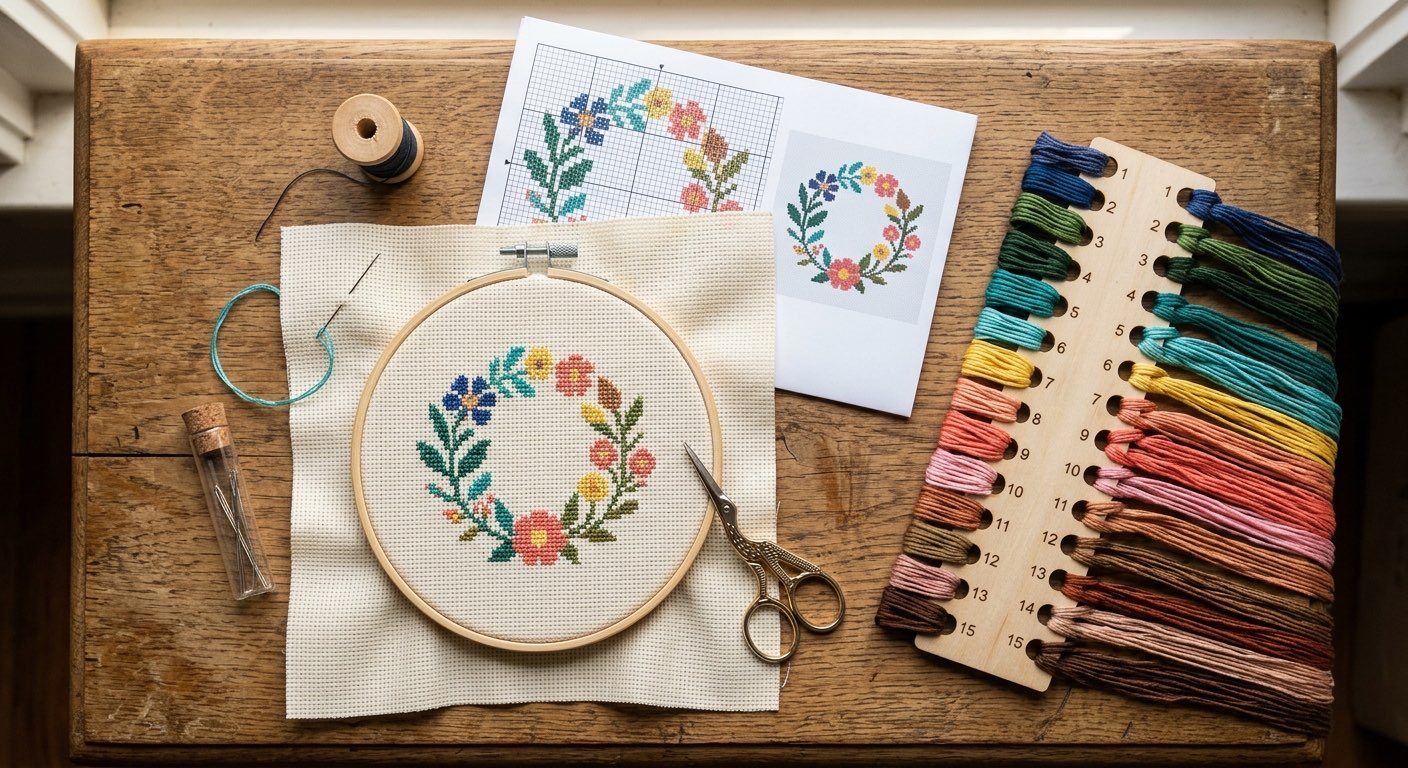
Top Kits for Beginners
1. Dimensions Learn-a-Craft Kits
Dimensions is one of the most reliable names in beginner needlework, and their Learn-a-Craft line is specifically designed for people who have never held a needle. The instructions are genuinely good — they include basic stitch guides, clear color keys, and the patterns are sized to finish in a reasonable amount of time.
The designs tend toward classic: floral motifs, seasonal themes, simple animals. Not trendy, but well-executed and satisfying to finish.
Pros:
- Instructions written for actual beginners
- Reliable thread quality
- 14-count Aida included
- Designs are sized to finish in a few sessions
Cons:
- Design aesthetics are traditional — not everyone’s taste
- Thread color selection is kit-specific (you can’t mix and match)
- Some designs feel dated
Best for: Anyone who wants a no-surprises first experience. These kits do what they promise. When you finish and want to buy individual skeins to match the colors, check our Dimensions to DMC conversion pages to find the equivalent DMC numbers.
Shop Dimensions Learn-a-Craft Kits on Amazon
2. Bucilla Beginner Kits
Bucilla makes both stamped and counted kits, and their beginner line is solid. The stamped options are particularly good for younger beginners or anyone with lower vision — the design is pre-printed on the fabric in blue ink, so you’re filling in color rather than counting every stitch from a grid.
Their counted kits are comparable to Dimensions in quality. Thread is consistently good, instructions are clear, and the designs skew seasonal and traditional.
Pros:
- Stamped option removes the counting challenge entirely
- Thread quality is reliable
- Wide design variety — something for everyone
- Usually slightly cheaper than Dimensions
Cons:
- Stamped kits teach a slightly different skill than counted cross-stitch (some stitchers want to learn counted from the start)
- Traditional aesthetic, similar to Dimensions
- Fabric in some kits is cut closer than ideal — not much margin to work with
Best for: Beginners who want a lower-frustration introduction, or anyone who prefers stamped work over counted.
Shop Bucilla Cross-Stitch Kits on Amazon
3. Dimensions Counted Mini Kits (Small Hoop Format)
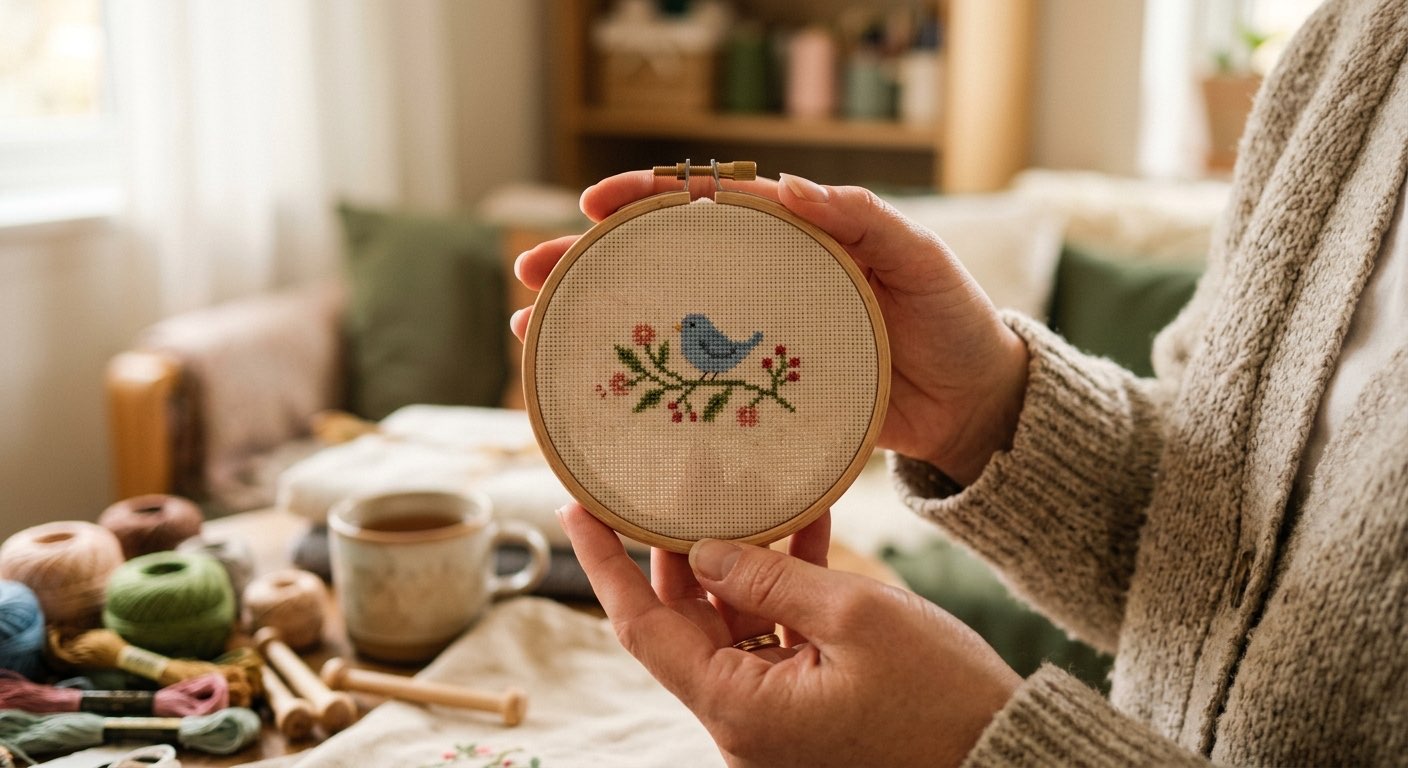
These small kits — designed to fit in a 4 or 5-inch embroidery hoop — are excellent for beginners who want something quick and displayable. They usually include a small hoop with the kit, so the finished piece is ready to hang without any additional framing decisions.
The designs in the mini format tend to be cleaner and simpler than the full-size kits, which actually makes them better for learning. Less color-switching, fewer confusing areas, faster progress.
Pros:
- Finishable in a single weekend
- Hoop included — it’s ready to display when done
- Simple designs reinforce fundamentals
- Inexpensive
Cons:
- Very small finished size — not a statement piece
- Thread colors included are exactly what you need and no more (no leftovers for practice)
- Fewer design choices than the full kit range
Best for: Beginners who want a fast win, or as a “try it before committing” purchase.
Shop Dimensions Mini Cross-Stitch Kits on Amazon
4. Vervaco Beginner Kits
Vervaco is a European brand that’s become easier to find on Amazon in recent years. Their beginner kits tend toward slightly more modern designs — cleaner graphics, less ornate, occasionally animal or nature motifs that feel contemporary rather than dated.
The quality is consistently good. 14-count Aida, decent thread, clear charts. If you’re turned off by the traditional aesthetic of Dimensions and Bucilla, Vervaco is worth a look.
Pros:
- More modern design aesthetic than US brands
- Solid fabric and thread quality
- Charts are well-organized and easy to read
- Some designs include specialty stitches as stretch challenges
Cons:
- Slightly more expensive than Dimensions or Bucilla
- Some designs have fine detail that requires patience
- Not as widely stocked — availability varies
Best for: Beginners who want something that looks a little less “craft store” and a little more contemporary.
Shop Vervaco Cross-Stitch Kits on Amazon
5. Modern Quote and Small Hoop Kits
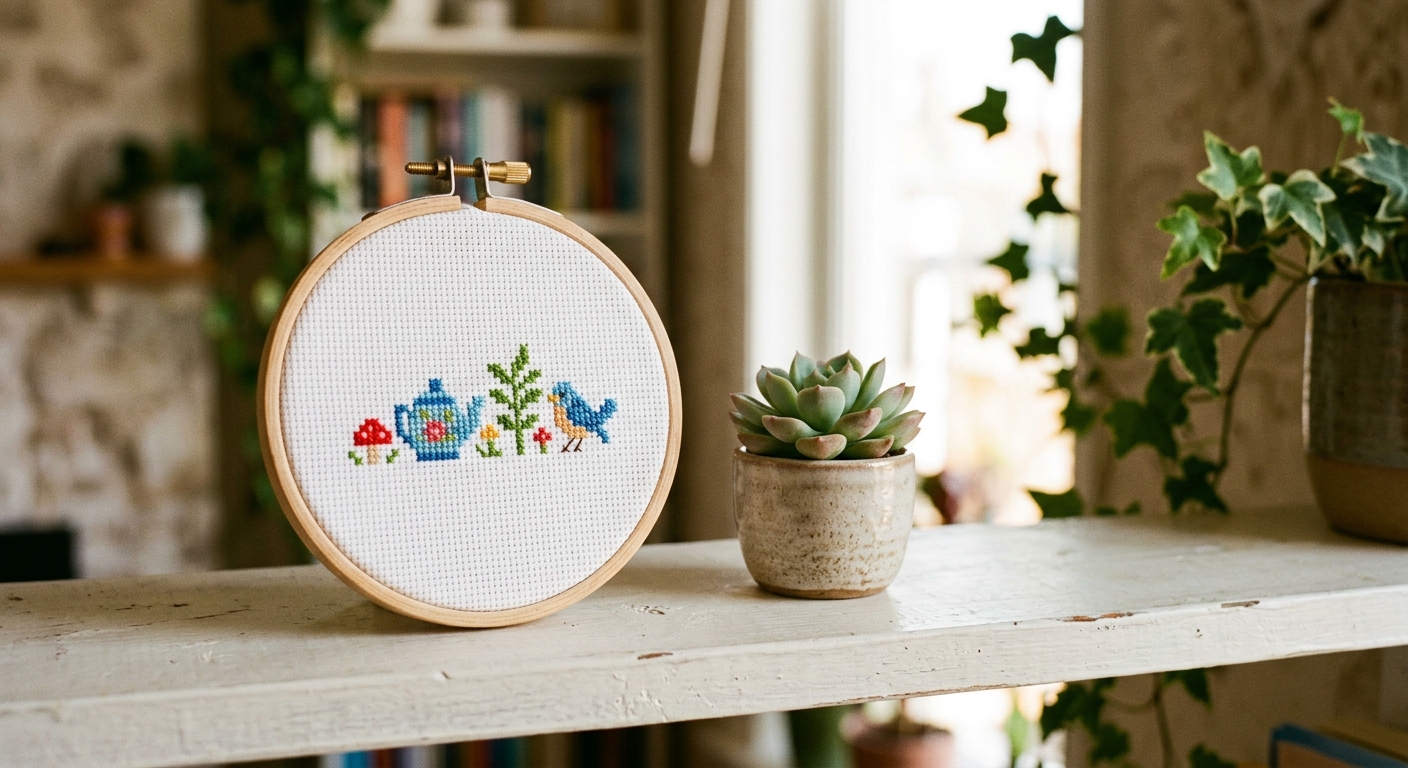
There’s a category of kits that have exploded in the last few years — small designs with bold text, sassy phrases, plants, or minimal geometric shapes, designed to fit in a 4 or 6-inch hoop and look at home in a modern apartment. Think “but first, coffee” or a simple avocado or a small celestial motif.
The quality varies. A lot of these come from smaller Etsy-adjacent brands on Amazon, and the thread quality and instruction quality range from excellent to genuinely bad. The ones that hold up: look for kits with clearly legible charts, thread labeled by DMC number (so you can buy replacements), and reviews that specifically mention instruction quality.
Pros:
- Designs feel current and personal
- Small size means fast finish
- Great for gifting
- Hoop usually included
Cons:
- Quality control is inconsistent across the category
- Some kits have charts that are nearly impossible to read
- Thread may not be labeled with brand/number, making it hard to replace
- Trendy designs can feel dated quickly
Best for: Beginners who are drawn to modern aesthetics and want something they’d actually hang on their wall. Just read reviews carefully.
Shop Modern Beginner Cross-Stitch Kits on Amazon
6. Stamped vs. Counted Cross-Stitch — Which Should You Start With?
This deserves its own section because it’s a genuine choice, not just a preference.
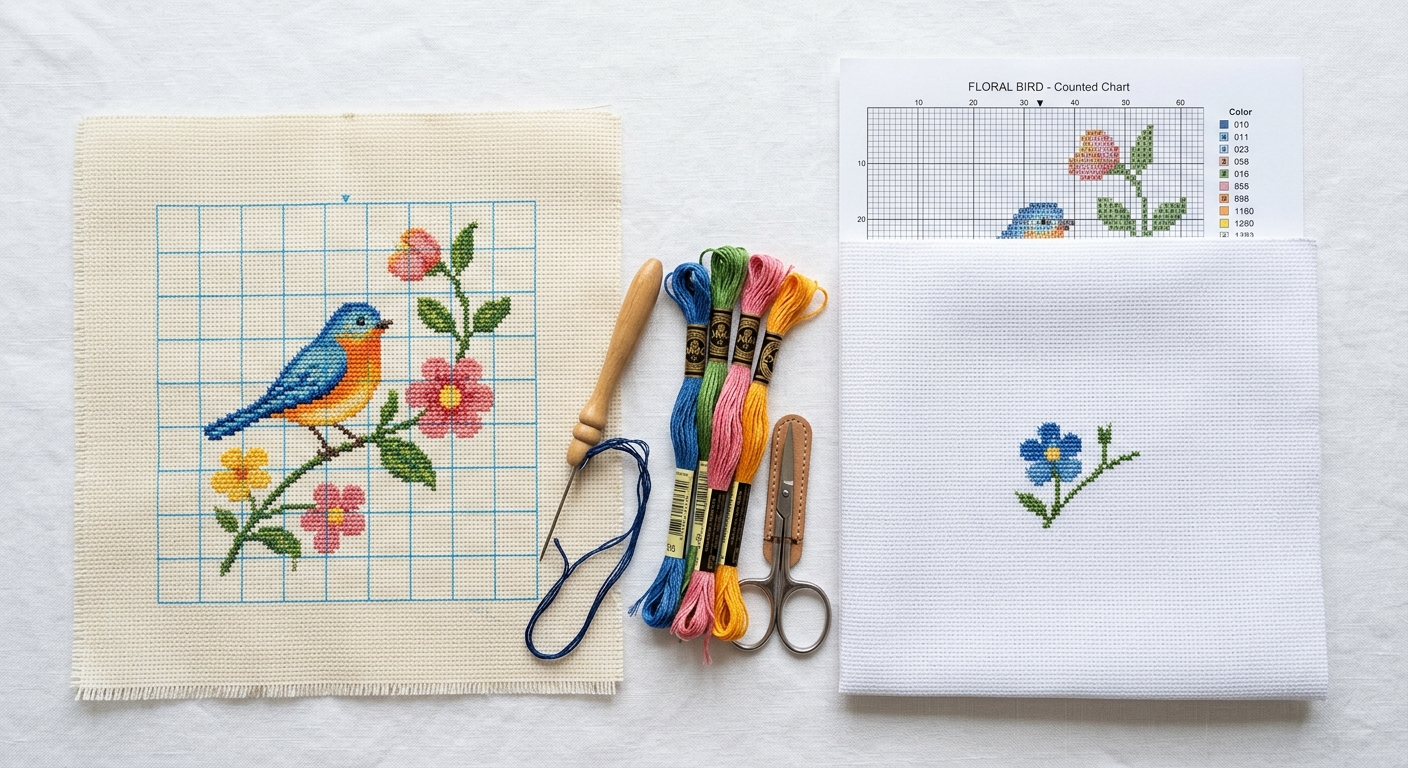
Stamped cross-stitch has the design pre-printed on the fabric. You stitch over the printed lines, filling in each area with the indicated color. It’s easier, faster, and requires less chart-reading. Many beginners find this more relaxing.
Counted cross-stitch has a blank fabric grid and a separate chart. You count squares to determine where each stitch goes. It requires more focus but teaches you to read patterns — which opens up a much larger world of designs, including free charts online, designer patterns from independent artists, and eventually designing your own work.
The honest answer: start with counted. The initial learning curve is steeper, but you’ll be able to do anything after. Stamped kits teach you the stitch; counted kits teach you the craft. That said, if stamped is what gets you to actually pick up a needle and start, then stamped is correct.
What to Avoid
Not all kits are equal, and some are genuinely not worth buying even at low prices.
No-name Amazon kits with no brand identity. If the kit doesn’t mention a brand name or has a brand name you’ve never heard of and can’t find elsewhere, be cautious. These kits frequently have illegible charts (sometimes because the chart image was simply printed too small), thread with no color labeling, and fabric that’s not Aida at all — just a rough weave that makes consistent stitching nearly impossible.
Anything with 22-count or higher fabric. There are beautiful 22 and 28-count projects out there, but none of them are suitable for beginners. The holes are tiny, threading the needle requires magnification, and mistakes are difficult to correct. If a kit is described as “fine detail” or “advanced evenweave,” skip it for now.
Kits where the design is larger than 8x10 inches. A beginner project should finish within weeks, not months. Large kits — particularly ones with dense solid fills or huge realistic portraits — require hundreds of hours of work. You’ll burn out before you’re done. Start small and build up.
Kits with no stitch count or estimated time listed. Reputable kits will give you some sense of scope. If that information is absent, it’s often because the kit is harder than it’s being marketed.
Essential Supplies Beyond the Kit
Most kits include what you need to get started, but a few additions make a real difference.
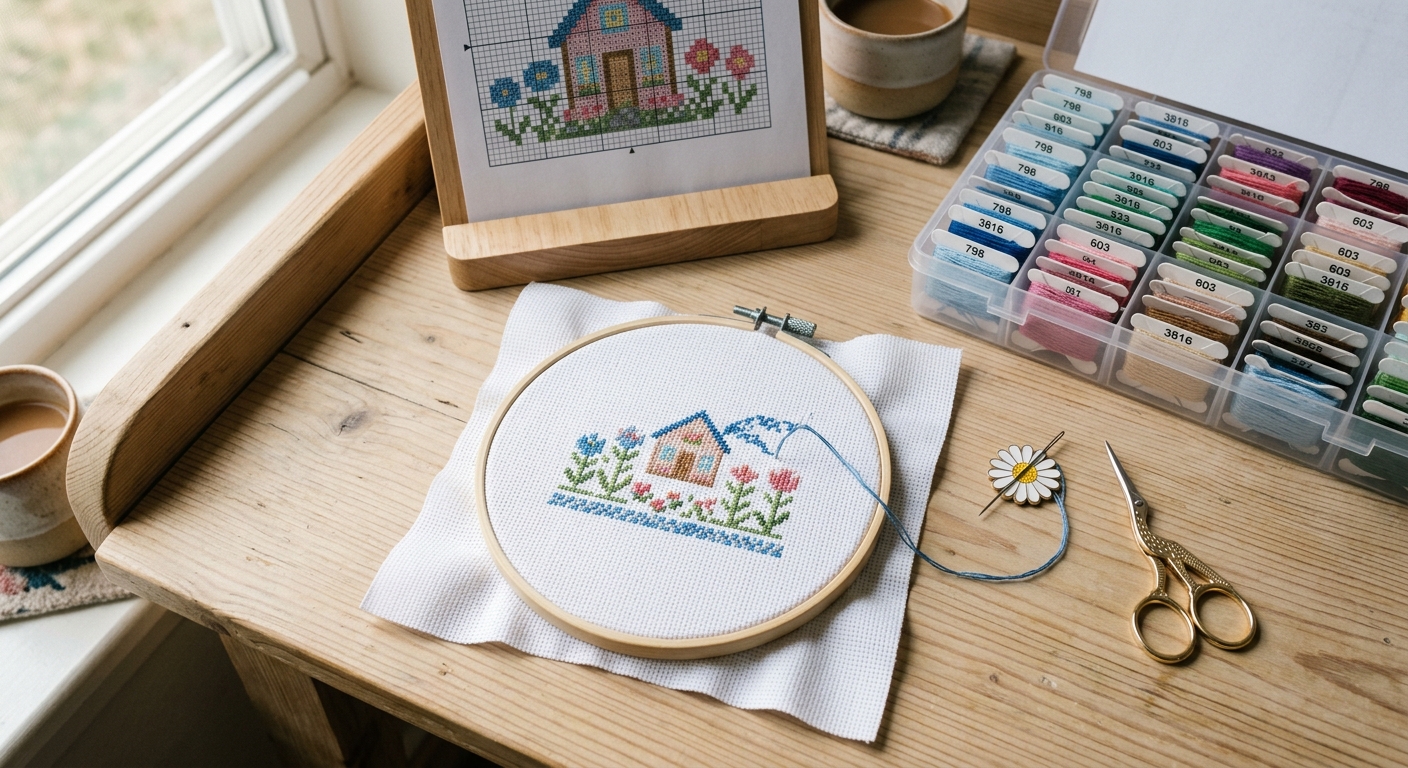
A good pair of embroidery scissors. The tiny scissors that come with some kits are fine, but a dedicated pair of sharp embroidery scissors — the kind with fine, pointed tips — makes cutting thread cleaner and closer to the fabric. Shop embroidery scissors on Amazon.
A needle minder. A small magnet that holds your needle when it’s not in use. It sounds trivial until you’ve spent 20 minutes looking for a needle on a couch cushion. Shop needle minders on Amazon.
A daylight or LED craft light. Stitching under dim or yellow light causes eye strain and makes it hard to see the holes in Aida clearly. A clip-on daylight lamp changes things significantly, especially for evening stitching. Shop daylight craft lamps on Amazon.
A hoop or Q-snap frame. Some kits include a hoop; many don’t. Stitching without a hoop leads to uneven tension and puckered fabric. Even a basic 6-inch plastic hoop — a few dollars — makes your stitching look better immediately. Shop embroidery hoops on Amazon.
When You Outgrow Kits
Kit stitching is a great way to learn, but most stitchers eventually want to go beyond what kits offer — choosing their own patterns, building a thread stash, and working with independent designers.
When that happens, one of the first things you’ll encounter is that patterns and stash-building often span multiple thread brands. A pattern might call for DMC; your local shop might carry Anchor. Or you’ll fall in love with a color in a kit (which might use Dimensions or Bucilla thread) and want to find the DMC equivalent to buy more.
That’s exactly what getstitchies.com is built for. Our color conversion pages cover DMC, Anchor, Madeira, Cosmo, and Sullivans — so when you run into a cross-brand situation, you can find the closest match fast. For example, if a pattern calls for DMC 310 Black, you can see its Anchor equivalent and Madeira equivalent in one place, with match quality noted. Popular beginner-friendly colors like DMC 321 Christmas Red, DMC 699 Christmas Green, and DMC 796 Dark Royal Blue all have full conversion pages. If you’re working with a Christmas-themed palette, we have a dedicated guide for that too.
Building your own stash is genuinely one of the joys of the craft. Kits are training wheels — good ones — but eventually you’ll want to ride without them.
Final Thoughts
The best beginner kit is the one that gets you stitching and keeps you stitching. For most people, that’s a Dimensions or Bucilla kit in the $10–$20 range on 14-count Aida, with a design that fits in your hand and finishes in a few weeks. Once you’re ready to branch out, browsing our color family pages — like the reds or blues — is a great way to start building your personal palette.
Don’t overthink the first one. Pick something you like the look of, buy it, and start. You’ll know what you want from the second kit after you finish the first.
Disclosure: This post contains affiliate links. We may earn a small commission at no cost to you when you purchase through these links. This helps support the site and allows us to continue creating free content.