Best Embroidery Floss Organizers for 2026
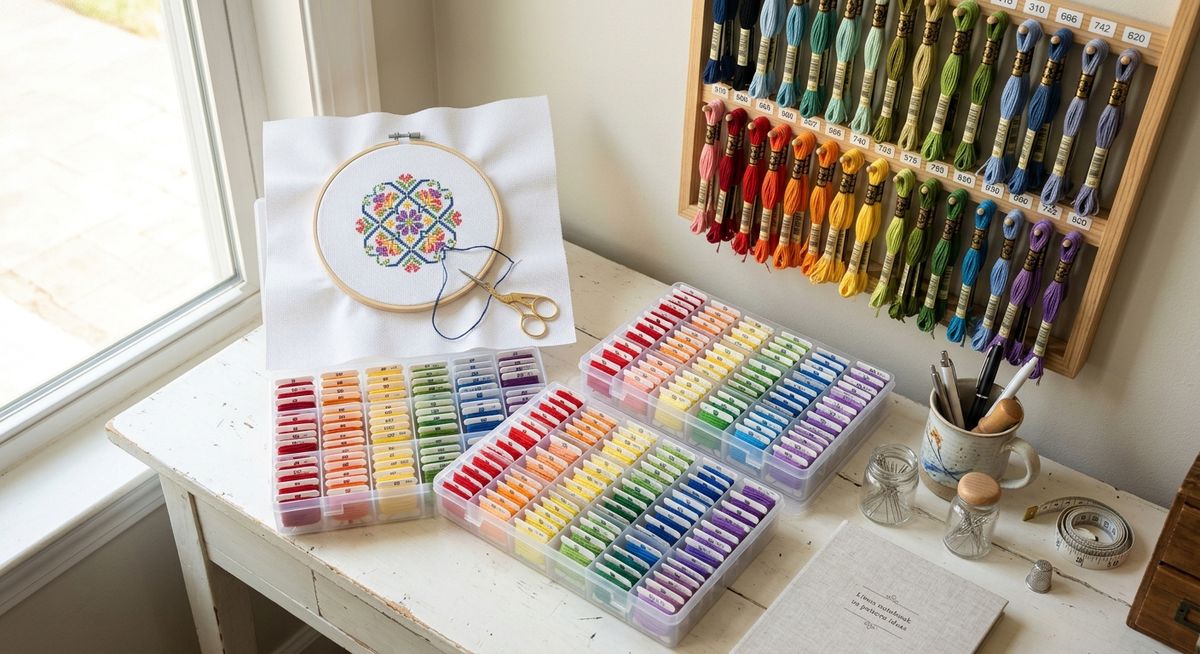
If you’ve ever reached into a craft bag and pulled out a bird’s nest of tangled DMC floss, you already know: good organization isn’t optional. It’s survival. Especially once you start building a stash across multiple color families and dozens of shades.
Whether you’re working through your first sampler or you’ve got a stash that rivals a small yarn shop, the right storage system makes the difference between a relaxing hobby and a 20-minute untangling session before you even thread a needle. This guide covers the best embroidery floss organizers available in 2026 — from budget-friendly bobbin boxes to dedicated thread cabinets — with honest takes on what works and what doesn’t.
Quick Comparison
| Organizer Type | Best For | Approx. Capacity | Price Range |
|---|---|---|---|
| Plastic bobbin boxes | Beginners, small stashes | 50–100 colors | $ |
| Binder + card system | Color-card style sorting | 100–300 colors | $–$$ |
| Plano tackle box | Travel, portable kits | 30–80 colors | $ |
| Thread rack/peg board | Visual display, large stash | 100–400 colors | $$–$$$ |
| DMC wooden cabinet | Serious collectors | 400–500 colors | $$$$ |
| Hanging organizer | Project-based kits | 20–50 colors per project | $ |
| Floss drop/bobbin winder | Any system | All sizes | $ |
How We Chose These Organizers
Picking storage solutions isn’t glamorous research, but it matters. Here’s what we looked for:
Capacity and scalability. A system that works for 50 colors should still work (or gracefully expand) when your stash reaches 200. We prioritized organizers that grow with you.
Label visibility. You need to see DMC numbers at a glance. Systems that hide labels or require you to pull threads out to read them are a daily frustration.
Tangle prevention. Bobbins, cards, and dividers exist for a reason. Loose skeins in a box are a recipe for chaos.
Portability vs. home storage. Not everything needs to travel. We tried to note which systems work best in each context.
Real-world durability. Plastic tabs that snap off after six months aren’t saving you money. We looked for products with consistently positive long-term reviews.
Price relative to value. You don’t need to spend $200 to have an organized stash. But some investments genuinely pay off.
The 7 Best Embroidery Floss Organizers
1. Floss-A-Way Bobbin Bags (The Classic System)
If you ask a roomful of experienced stitchers what they use, a significant number will say Floss-A-Way bags — or some variation of the small punch-hole bag with a hanging ring system. The basic idea is simple: each color gets its own small zip bag with a hole at the top, labeled with the DMC number, hung on a ring or stored in a binder.
How it works: You wind your floss onto a card or leave it as a skein, slide it into the bag, label the outside, and hang the bags by color family or number sequence. Many stitchers store these in three-ring binders with baseball card pages.
Pros:
- Virtually no tangling — each color is fully enclosed
- Labels stay visible and intact
- Scales infinitely (just add more bags and rings)
- Easy to pull a single color for a project kit without disturbing the rest
- Works with DMC, Anchor, Madeira — any brand
Cons:
- Initial setup is time-consuming if you’re converting an existing stash
- The bags themselves can be hard to find locally (easier online)
- Not the most visually appealing system if you like seeing your colors on display
Best for: Stitchers with mid-to-large stashes who want a no-tangle, scalable system and don’t mind a one-time setup investment.
Shop Floss-A-Way Bag Systems on Amazon
2. Plastic Bobbin Storage Box (The Budget Workhorse)
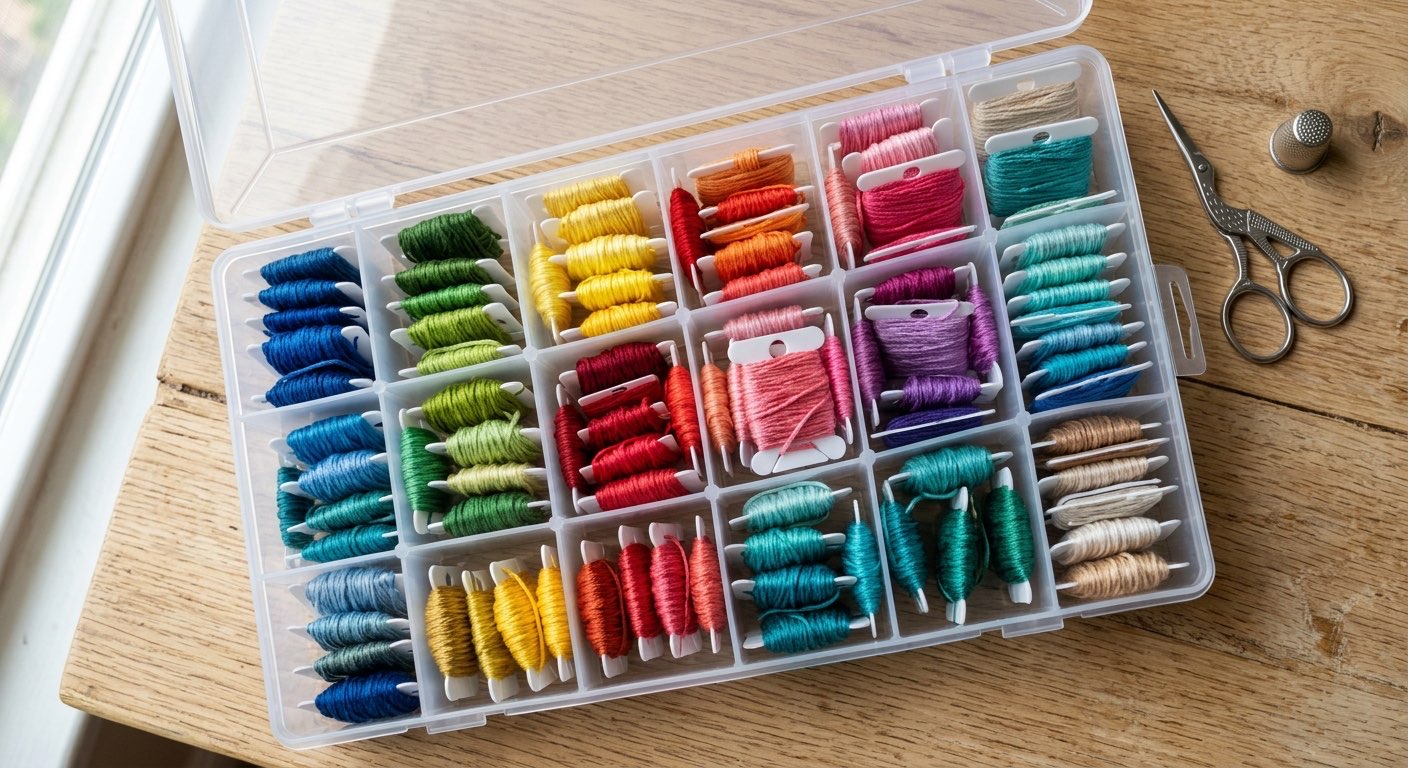
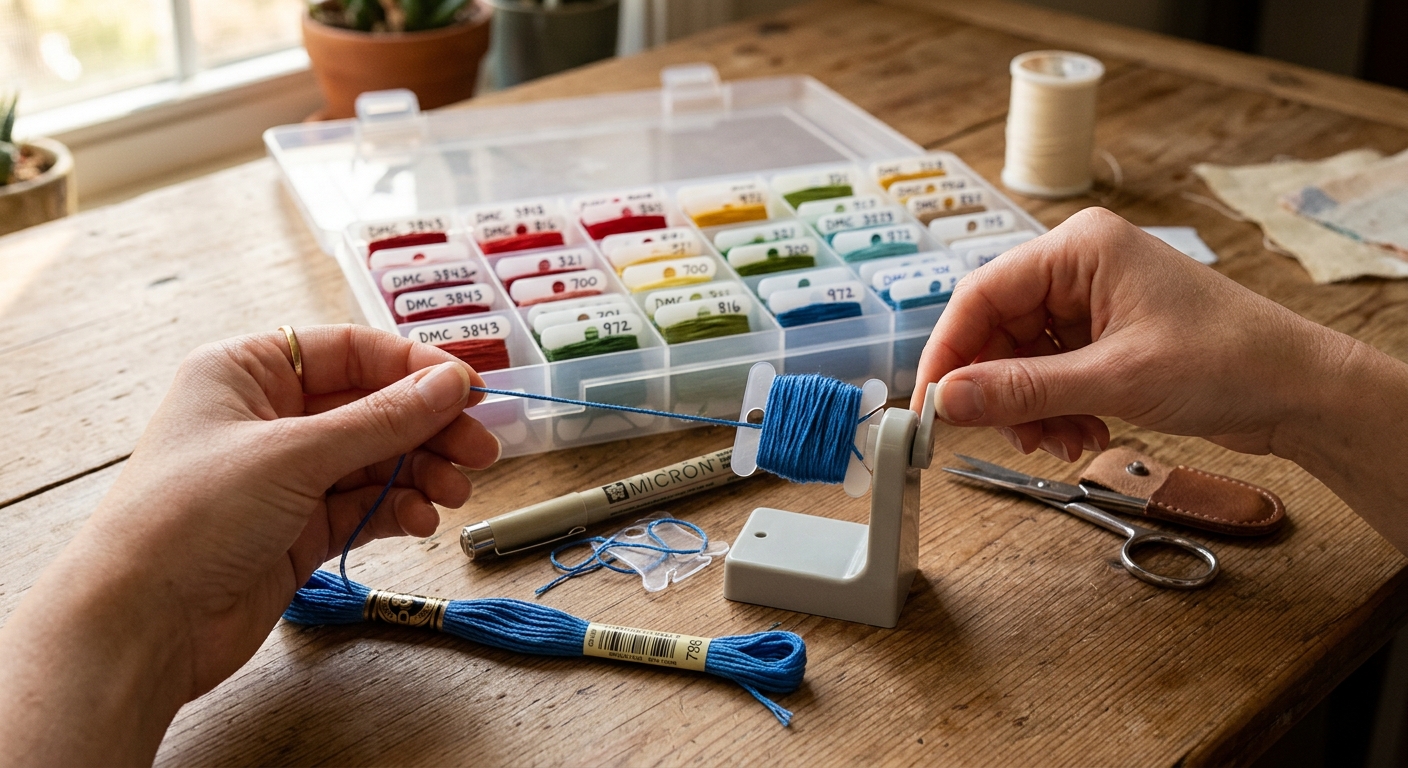
For many beginners, the first stop is a plastic craft box with individual compartments — the kind with adjustable dividers and a snap-shut lid. Pair it with flat plastic or cardboard bobbins, wind your floss, and sort by number or color family.
These boxes are sold by nearly every craft brand and come in sizes ranging from 17 slots to 60+. The DMC-branded version is popular, but generic versions work just as well.
How it works: Wind floss onto bobbins (plastic or cardboard), write the DMC number on the bobbin, and slot them into compartments. Most boxes hold the bobbins on edge so you can read numbers at a glance.
Pros:
- Very inexpensive to start
- Bobbins keep floss tangle-free
- Color visible at a glance
- Durable plastic construction
Cons:
- Fixed compartment sizes may not work for thick or specialty threads
- Bobbin winding is meditative for some, tedious for others
- A full DMC collection (500 colors) requires 8–10 boxes
- Boxes don’t lock together neatly — stacking can be wobbly
Best for: Beginners building their first stash, anyone on a tight budget, or stitchers who want a simple system they can start using today.
Shop Plastic Floss Bobbin Boxes on Amazon
3. Plano Tackle Boxes (The Surprisingly Great Option)
Here’s the open secret in cross-stitch organization circles: fishing tackle boxes are often better than craft-specific storage, and significantly cheaper. Plano’s 3600 and 3700 series in particular have earned a devoted following among stitchers for their adjustable dividers, secure latches, and stackable design.
The compartments are slightly larger than most craft boxes, which is helpful for thicker threads or keeping skeins partially wound.
Pros:
- Adjustable dividers — customize compartment size per thread type
- Sturdy, latch-secure lids that won’t pop open in a bag
- Stackable and sold in sets
- Often cheaper than craft-branded equivalents
- Widely available in sporting goods stores and online
Cons:
- No label system built in — you’ll need to label compartments yourself
- Not designed for stitchers, so no DMC-specific features
- Slightly deeper than needed for standard bobbins, so threads can shift
Best for: Stitchers who want the most storage per dollar, or anyone who needs a portable kit that can survive a bag or travel case.
Shop Plano Tackle Box Storage on Amazon
4. Binder + Floss Cards System (The Collector’s Method)
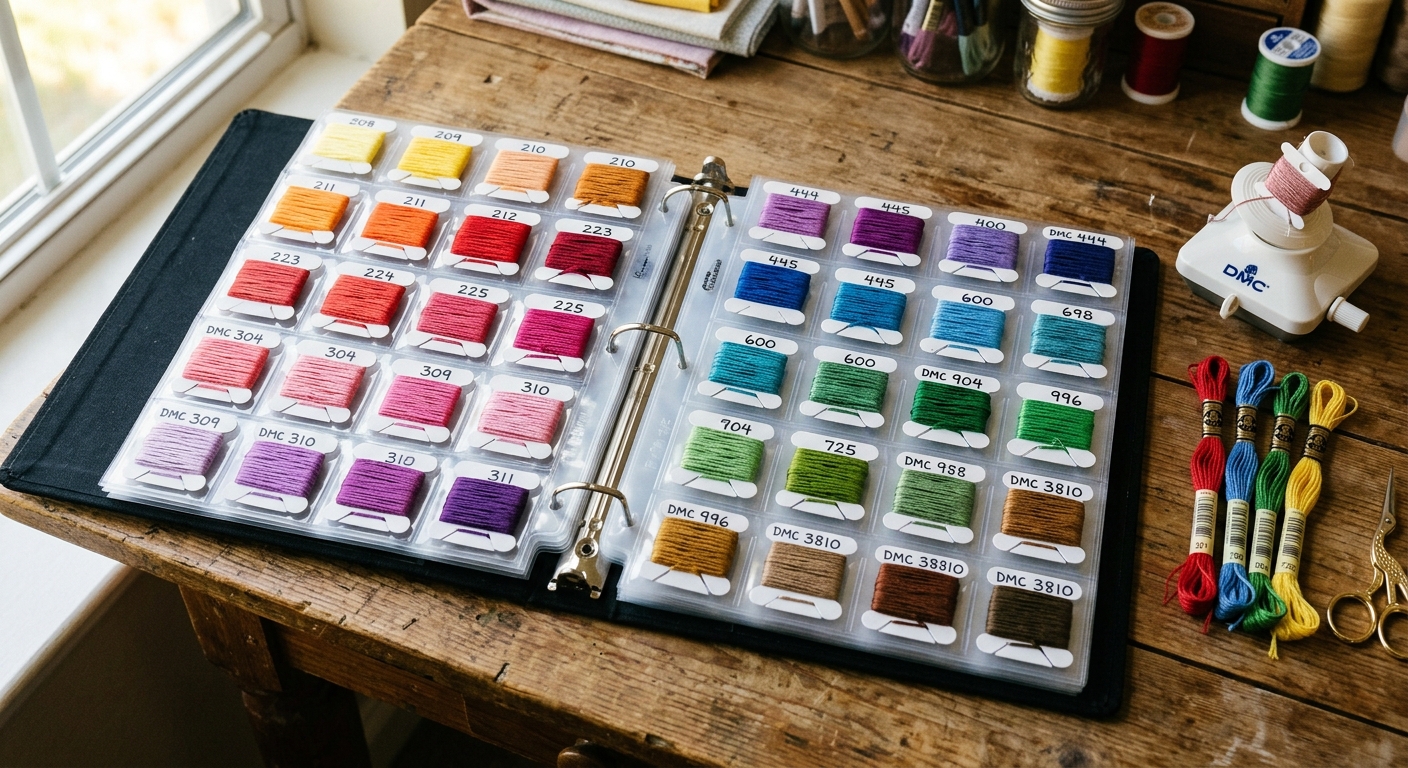
If you like seeing your full color card — and if having a beautiful, sorted reference feels important to you — the binder system is worth the setup time. The concept: each color is wound onto a cardstock or plastic floss card, stored in a clear sleeve, and organized in a three-ring binder, usually in numerical order.
Some stitchers use the official DMC cardboard cards; others use generic plastic bobbins in baseball card sleeves. Either way, the binder lets you flip through your collection like a color swatch book.
Pros:
- Extremely visual — you can see every color you own at once
- Easy to check which colors you have without a separate inventory
- Binders are portable and flat
- Works beautifully for reference when planning color palettes
Cons:
- Cards can loosen and fall out of sleeves over time
- Sleeves add cost and must be the right size (floss cards aren’t standard dimensions)
- Winding each skein onto a card is time-consuming
- Binders add bulk — a full DMC collection fills 3–4 thick binders
Best for: Collectors who enjoy the process of organizing, anyone who wants a visual reference library, or stitchers who frequently choose colors by eye rather than pattern number.
Shop Floss Cards and Binder Storage on Amazon
5. Thread Racks and Peg Boards (The Display Option)
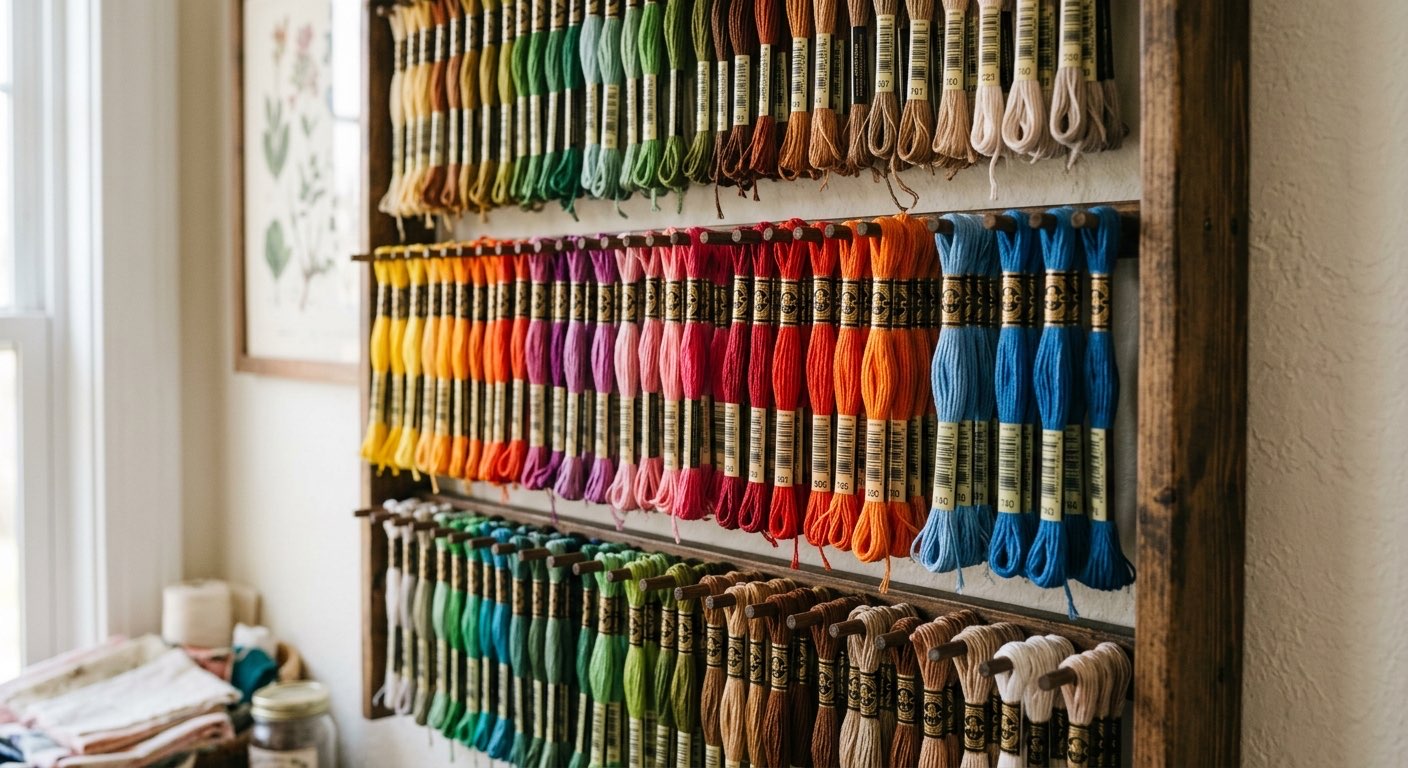
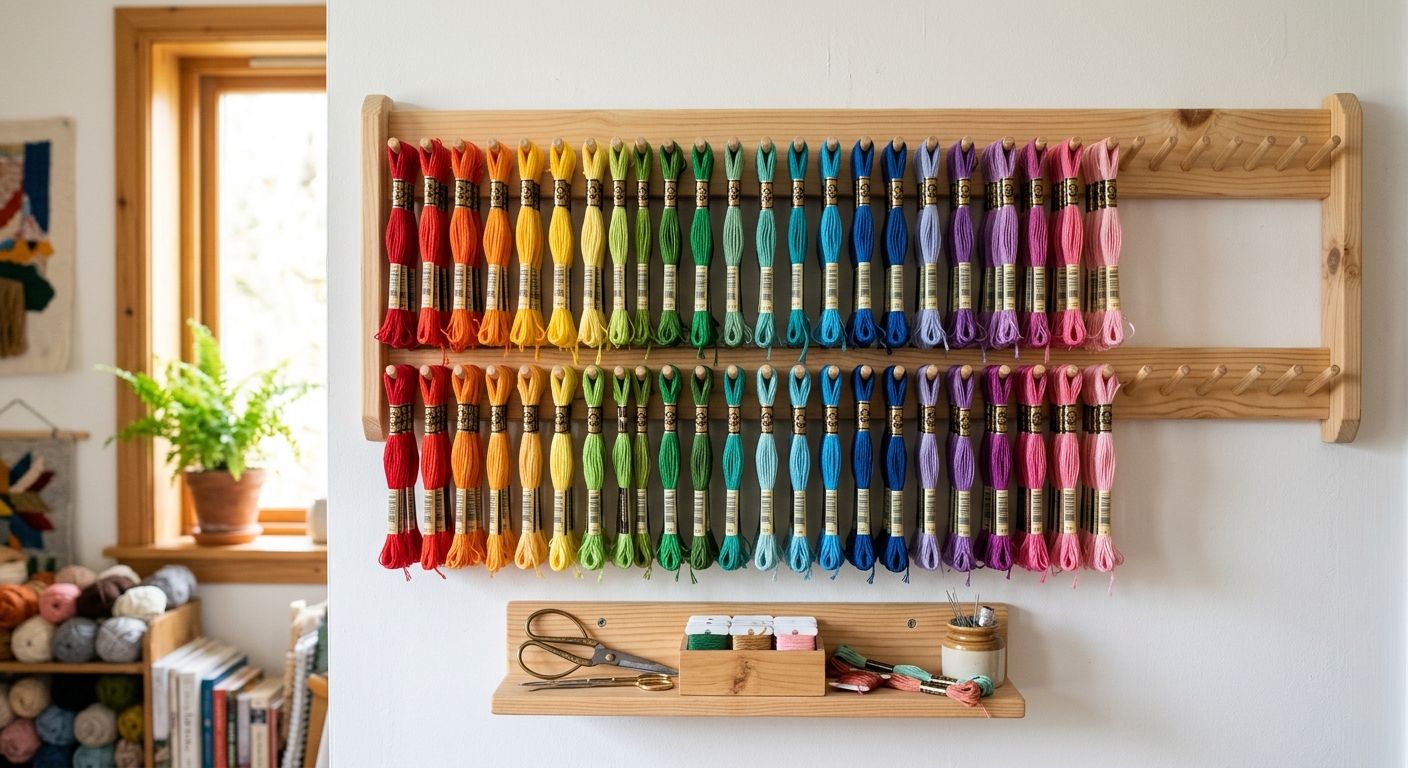
For stitchers who want their stash on display — and who have wall space to spare — thread racks and peg board systems are the most visually satisfying option. Skeins hang from pegs, sorted by color family, creating the kind of rainbow wall that turns a craft room into a space you actually want to be in.
Wooden thread racks designed for embroidery floss hold anywhere from 50 to 400 skeins depending on size. Some are designed to sit on a desk; others mount on a wall.
Pros:
- Visually stunning — your stash becomes part of your room’s decor
- No winding required — skeins hang as purchased
- Easy to grab and replace colors
- Great for color planning — you can literally see your whole palette
Cons:
- Exposed to light and dust — can fade colors over time
- Skeins can slip off pegs and tangle if bumped
- Wall-mounted systems aren’t practical in rented spaces
- Not portable at all
Best for: Stitchers with dedicated craft rooms who want a beautiful, accessible display. Not ideal for travel or if you’re sensitive to color fading from light exposure.
Shop Embroidery Thread Racks on Amazon
6. DMC Wooden Storage Cabinet (The Investment Piece)
DMC makes a dedicated wooden storage cabinet specifically designed for their full thread line. It’s expensive — this is an investment, not an impulse buy — but for stitchers who own (or plan to own) a significant portion of the DMC catalog, it’s genuinely purpose-built for the job.
The cabinet includes labeled slots for each DMC color number, a hinged door, and is designed to sit on a shelf or craft table. It holds up to 500 skeins in the full-sized version.
Pros:
- Purpose-built for DMC floss — every slot is labeled
- Solid construction, attractive appearance
- No winding required — skeins slot in directly
- A one-time purchase that can last decades
Cons:
- Expensive upfront cost
- Only works well if you’re primarily a DMC stitcher
- Takes up significant shelf space
- Not portable
Best for: Serious collectors who own or plan to own a substantial DMC collection and want a permanent, organized home for it. If you’re converting from Anchor or Madeira (use our color conversion tools to find equivalents), this pairs naturally with building out a full DMC stash. Start with high-use colors like DMC 310 Black and DMC 666 Bright Red, then fill in from there.
Shop DMC Thread Storage Cabinets on Amazon
7. Project Zip Bags and Hanging Organizers (The Kit Method)
Sometimes the best organization isn’t about your whole stash — it’s about having a clean, ready-to-grab kit for each active project. Small hanging organizers with labeled pockets, or simple zip bags with the relevant colors pulled and tagged, keep your current WIP from eating into your main storage.
This isn’t a replacement for a full stash system, but it’s an essential companion to one. Pull the colors you need for a project, tag them with the symbol from the pattern, and keep them separate.
How it works: Use a hanging organizer (like a shoe organizer with small pockets) or individual zip bags labeled by project. Include the relevant color codes, the pattern, and your needle and hoop in one kit.
Pros:
- Makes project transitions fast — grab the bag, start stitching
- Protects your main stash from constant in-and-out
- Great for travel projects
- Very inexpensive
Cons:
- Not a stash storage solution — requires a separate main system
- Zip bags add plastic waste over time
- Can become cluttered if you have many active projects
Best for: Anyone juggling multiple WIPs, stitchers who travel with projects, or as a companion system to any of the main storage methods above.
Shop Project Organizer Bags for Embroidery on Amazon
Tips for Setting Up Your System
Sort by number, not color family. It’s tempting to sort by hue — all the blues together, all the greens together — but when a pattern calls for DMC 312, you want to find it in three seconds, not scan every shade of navy you own. Numerical order is faster for pattern following.
Label everything twice. Write the DMC number on the bobbin or card, and on the compartment or sleeve. When threads shift or get pulled out, you always know where they go back.
Build a separate “low stock” system. Keep a small box or list of colors you’re running low on. Restocking is much easier than realizing mid-project that you have six inches of DMC 310 Black left when you’re backstitch-happy — or discovering you’ve used your last skein of DMC 321 Christmas Red halfway through a holiday sampler.
Color families matter for browsing, not storing. Keep your storage numerical, but use color family knowledge when planning palettes. Our color family guide can help you understand which colors work together and why.
Don’t feel locked in. Many stitchers use hybrid systems — bobbins for most of their stash, a hanging rack for frequently used colors, project bags for active WIPs. There’s no single right answer.
What About Anchor, Madeira, and Other Brands?
Most of the storage systems above work fine for any brand of embroidery floss — the physical format is similar enough that bobbins, bags, and boxes don’t care whether they’re holding DMC or Anchor. The main challenge with multi-brand stashes is labeling: make sure you include the brand name alongside the color number, since DMC 310 and Anchor 403 are both labeled with numbers that could overlap. Our DMC 310 to Anchor conversion page shows exactly how these map.
If you’re converting between brands (picking up Anchor because your local shop is out of a specific DMC shade, for example), we have conversion guides for every major color. Try DMC 699 Christmas Green or DMC 796 Dark Royal Blue to see what the Anchor and Madeira equivalents look like, and explore our full color conversion categories to find equivalents across your stash. Our Christmas palette guide is a great place to see how colors group together across brands.
Final Thoughts
There’s no universally perfect floss organizer — the right choice depends on your stash size, how you prefer to work, and whether portability or display matters to you. But any system is better than loose skeins in a bag, and most of these options are inexpensive enough that you can try one without much risk.
If we had to pick one recommendation for most stitchers: start with a plastic bobbin box and bobbins. It’s cheap, it works, it scales, and if you later decide you want to upgrade to Floss-A-Way bags or a binder system, you’ve lost nothing. The bobbin habit is useful in any system.
If you’re building out a full DMC stash and want the most satisfying long-term home for it, the Floss-A-Way bag system with a binder is arguably the most scalable and tangle-proof option available, and it’s the one you’ll still be happy with five years from now.
Happy stitching — and may your threads stay untangled.
Disclosure: This post contains affiliate links. We may earn a small commission at no cost to you when you purchase through these links. This helps support the site and allows us to continue creating free content.