Best Magnifying Lamps for Cross-Stitch (2026 Tested)
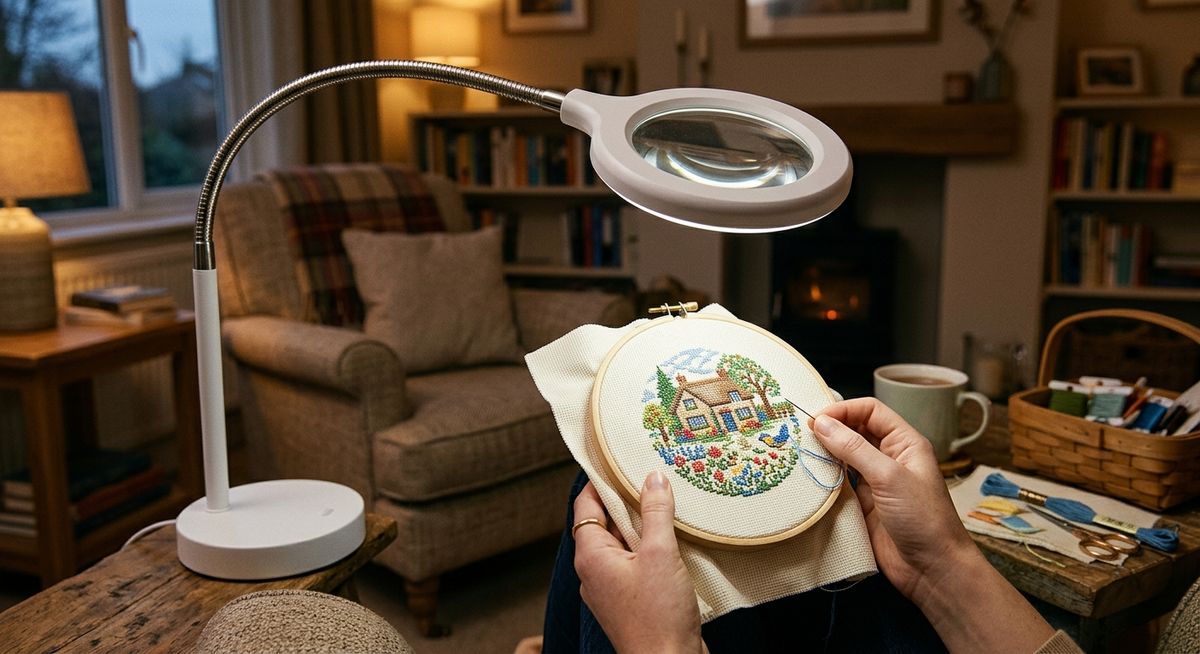
If you’ve ever squinted at an 18-count evenweave under a regular ceiling light trying to figure out whether that thread is DMC 3750 or DMC 336, you already know the problem. Good lighting isn’t a nice-to-have for cross-stitch — it’s the difference between enjoying a long stitching session and ending it with a headache and a mistakes you have to frog out.
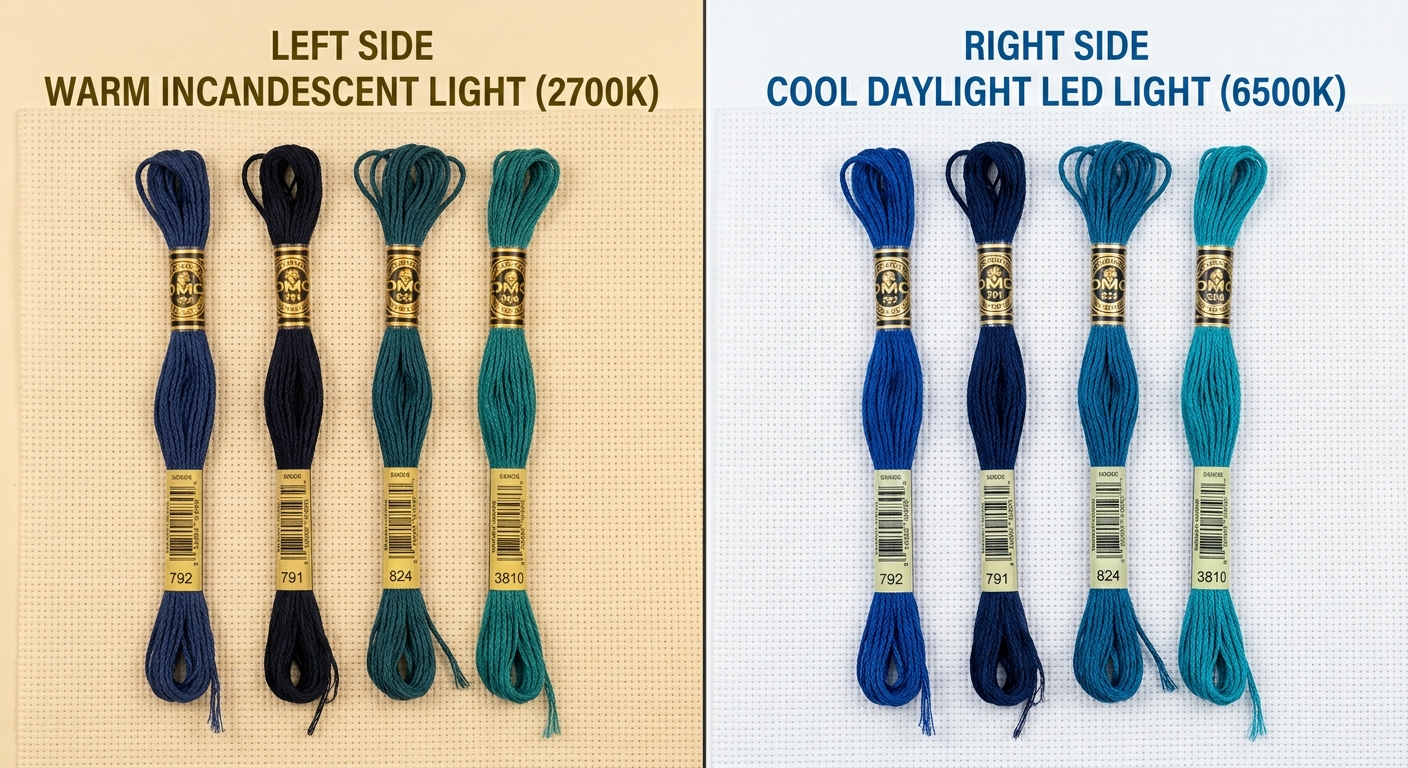
This is especially true when you’re working from thread conversion charts. The color differences between brands can be extremely subtle. A DMC to Anchor conversion might pair two threads that look almost identical in the store but read differently under bad light — and you won’t know until you’ve already stitched three rows. Daylight-balanced lighting catches those nuances. Incandescent warm light washes them out.
Here’s what actually works.
Quick Comparison
| Lamp | Type | Magnification | Light | Price Range | Best For |
|---|---|---|---|---|---|
| Brightech LightView Pro | Floor lamp | 2.25x (5 diopter) | Daylight LED | $70–90 | Living room stitching |
| Daylight Company Slimline | Desk/floor | 1.75x (3 diopter) | Daylight LED | $80–120 | Dedicated craft desk |
| Fancii LED Clip-On | Clip-on | 2x–4x | Daylight LED | $25–40 | Travel, portability |
| Neatfi Bifocals | Desk mount | 2.25x (5 diopter) | Daylight LED | $60–80 | Small apartment setups |
| Ottlite Refine | Desk lamp | None (lighting only) | Daylight LED | $50–70 | General task lighting |
| Carson Optical DeskBrite | Clip/stand | 2x | Daylight LED | $30–45 | Budget option |
| Luxo Luxiflex | Articulating arm | 3x (8 diopter) | Daylight LED | $150–200 | Detail work, professionals |
Top Picks
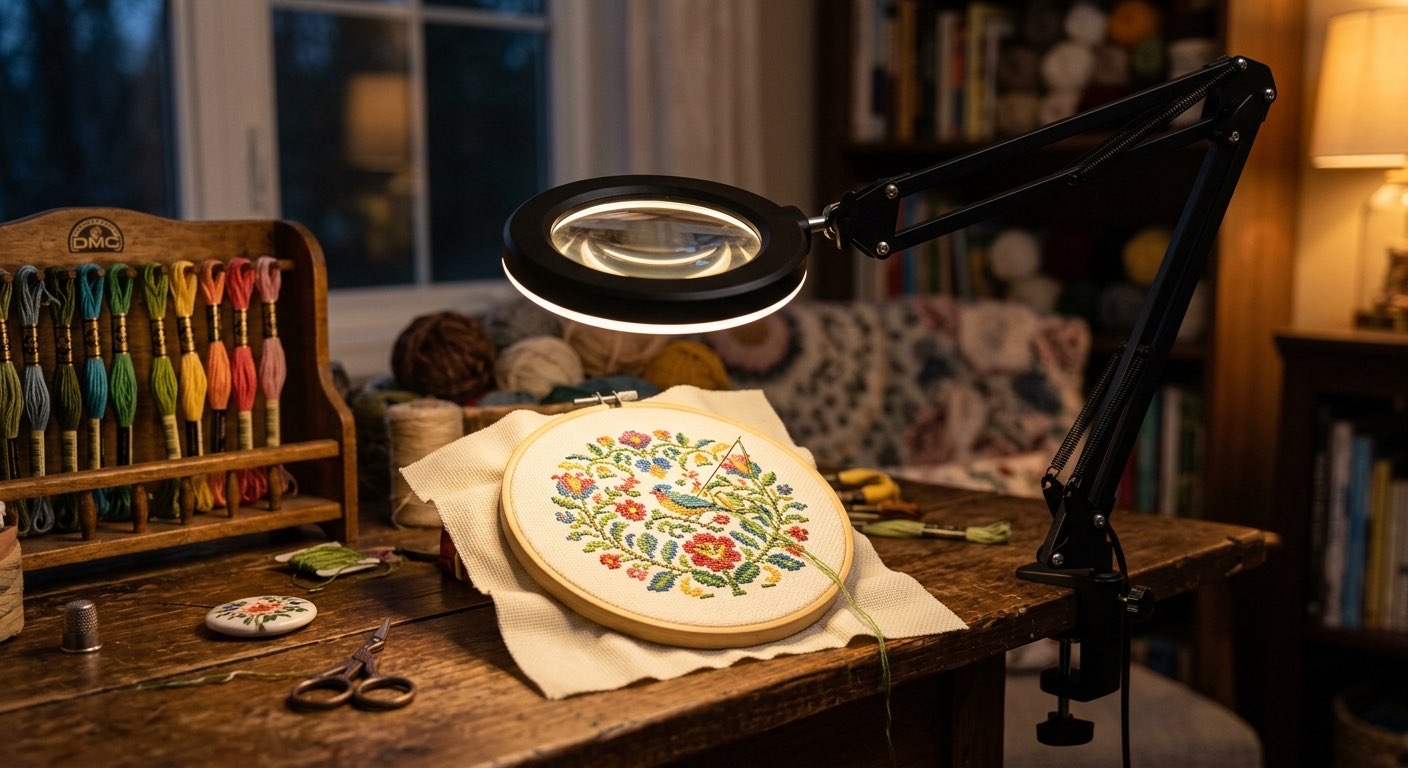
Brightech LightView Pro — Best Overall Floor Lamp
The LightView Pro is the lamp that comes up again and again in needlework forums, and there’s a reason for it. The floor-standing design puts the magnifying lens exactly where you need it without eating up desk or table space, and the flexible gooseneck arm adjusts to almost any angle.
The 5-diopter lens translates to about 2.25x magnification — not extreme, but right in the sweet spot for 14-count or 18-count aida. The LED panel around the lens is color-balanced to 6000K daylight, which renders thread colors accurately and doesn’t create the yellow cast that makes darker colors bleed together.
Browse Brightech LightView Pro on Amazon
Pros:
- Freestanding, no clamp or desk space needed
- True daylight LED color temperature
- Flexible arm with good range of motion
- Relatively quiet fan-free design (no heat)
- Large lens diameter covers the whole work area
Cons:
- Base can be in the way in tight spaces
- 2.25x won’t be enough for very high-count fabrics like 28-count evenweave
- Lens cover scratches easily over time
Daylight Company Magnifying Lamps — Best for Serious Crafters
Daylight Company makes lamps specifically for needlework and detail crafts, and it shows. Their lamps use what they call “Natural Daylight” LEDs — a proprietary color profile tuned closer to noon sunlight than generic daylight LEDs. The difference is visible when you hold threads side by side: colors don’t shift the way they do under cheaper lights.
Their Slimline floor lamp and desk-mounted options both work well. The floor version is comparable to the LightView Pro but with a slimmer profile and more premium build quality. If you’re putting together a dedicated craft corner, this is worth the extra spend.
Browse Daylight Company lamps on Amazon
Pros:
- Purpose-built for crafts — not repurposed from office use
- Superior color accuracy compared to generic daylight LEDs
- Durable, well-made hardware
- Available in multiple form factors
Cons:
- Noticeably more expensive than alternatives
- Replacement bulbs/parts can be hard to find retail
Clip-On Magnifying Lamps — Best for Portability
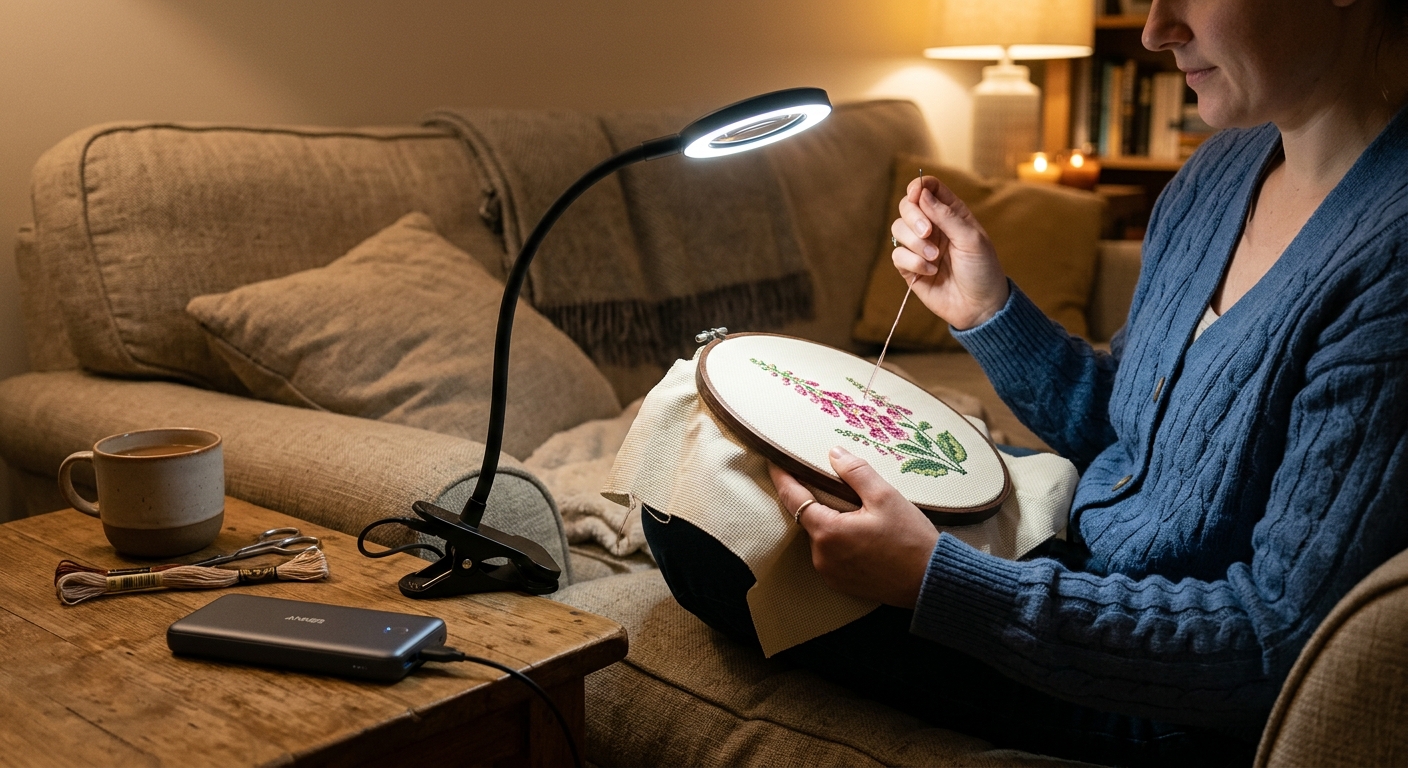
If you stitch in multiple spots — the sofa, a craft room, travel — a clip-on is worth having even if you also own a floor lamp. The Fancii LED Magnifying Lamp is the one worth looking at. It clips to the edge of any flat surface, runs on USB power (which means a phone charger or power bank works), and offers multiple magnification levels via swappable lenses.
The light quality on clip-ons is generally a step below dedicated craft lamps, but the better USB-powered models are surprisingly decent for travel use.
Pros:
- Takes up almost no space
- USB-powered — works anywhere
- Inexpensive
- Good for stitching on the go or in different rooms
Cons:
- Light coverage is smaller than a full floor or desk lamp
- Clip can damage some surfaces
- Lower-end optics compared to dedicated craft lamps
Neatfi Bifocals Desk Lamp — Best for Small Spaces
If a floor lamp doesn’t work for your setup, the Neatfi Bifocals is one of the better desk-mounted magnifying lamps. It uses a weighted base rather than a clamp, so it doesn’t require a desk edge, and the articulating arm gives you a wide reach without being unwieldy. The 5-diopter lens gives the same 2.25x magnification as the LightView Pro.
Browse Neatfi magnifying lamps on Amazon
Pros:
- Weighted base — no clamping required
- Takes up minimal desk footprint
- Solid build at a mid-range price
- Bright, even LED panel
Cons:
- Base is heavier than it looks — not great for travel
- Arm reach is shorter than floor lamp options
Ottlite Refine Desk Lamp — Best Pure Lighting (No Magnification)
Not everyone needs magnification. If your main issue is eye strain from poor color rendering rather than difficulty seeing fine detail, the Ottlite Refine is worth considering. It’s a task lamp — no magnifying lens — but it uses Ottlite’s “ClearSun LED” technology, which the company claims reduces eye strain versus standard LEDs.
For color matching threads, good neutral daylight matters more than magnification power. If you’re working on 14-count with normal eyesight and your real problem is that the room light makes DMC 930 Dark Antique Blue and DMC 931 Medium Antique Blue look identical, a quality daylight task lamp may solve it without the bulk of a magnifying floor lamp.
Browse Ottlite desk lamps on Amazon
Pros:
- Slim, unobtrusive design
- Genuinely good color rendering
- Good for people who don’t need magnification
- Works well paired with reading glasses
Cons:
- No magnification — not suitable if that’s your primary need
- Smaller light panel than craft-specific lamps
Carson DeskBrite — Best Budget Option
Under $40, the Carson DeskBrite gives you a clip-on or freestanding magnifying lamp with LED lighting and a 2x lens. It’s not going to replace a Daylight Company lamp, but it’s a legitimate step up from stitching under a random desk lamp, and the price makes it easy to recommend as a first purchase.
Browse Carson DeskBrite on Amazon
Pros:
- Very affordable entry point
- Flexible — clips or stands
- LED lighting is decent for the price
Cons:
- Light color isn’t true daylight — slightly warm
- Smaller lens than premium options
- Build quality is noticeably lower than mid-range picks
What to Look For
Daylight vs. Warm Light
This is the most important spec and the one most people overlook. Daylight-balanced LEDs run around 5000–6500 Kelvin. Warm LEDs are 2700–3000K. For cross-stitch, you want daylight — always.
Warm light makes reds pop and blues flatten. Thread colors that are clearly different under neutral light can look nearly the same under a warm bulb. If you’re doing any kind of color-critical work — matching threads, working from a printed chart, comparing brands — warm light actively makes the job harder.
Magnification and Diopters
Magnifying lens strength is measured in diopters. The math that converts diopters to magnification is: divide the diopter number by 4, then add 1.
- 3 diopter = 1.75x
- 5 diopter = 2.25x
- 8 diopter = 3x
- 10 diopter = 3.5x
For most cross-stitch on 14-count to 18-count aida, 5 diopter (2.25x) is the sweet spot. It enlarges enough to see individual holes clearly without the distortion that comes with higher magnification. If you’re working 28-count or higher, or doing hardanger or specialty stitches, 8 diopter starts to make sense.
Higher magnification also means a shallower focal depth — you have to hold the work closer to the lens. Some people find this uncomfortable. Try before you commit if you can.
Adjustability
A lamp you can’t position correctly is a lamp you won’t use. Look for:
- Arm length long enough to reach your lap if you’re in a chair
- Lens that tilts, not just swivels
- A stable base that won’t tip when the arm is extended
Floor lamps generally win here because the base is heavy enough to counterbalance a long arm. Desk clamps are the weak point in most clip-on designs.
LED vs. Fluorescent
LED is the right answer here, full stop. LED craft lamps run cooler, last longer, don’t flicker, and render colors more accurately than fluorescent. If you find a magnifying lamp that still uses a circular fluorescent tube, skip it — replacements are increasingly hard to find and the color quality isn’t worth the trouble.
Budget Options That Actually Work
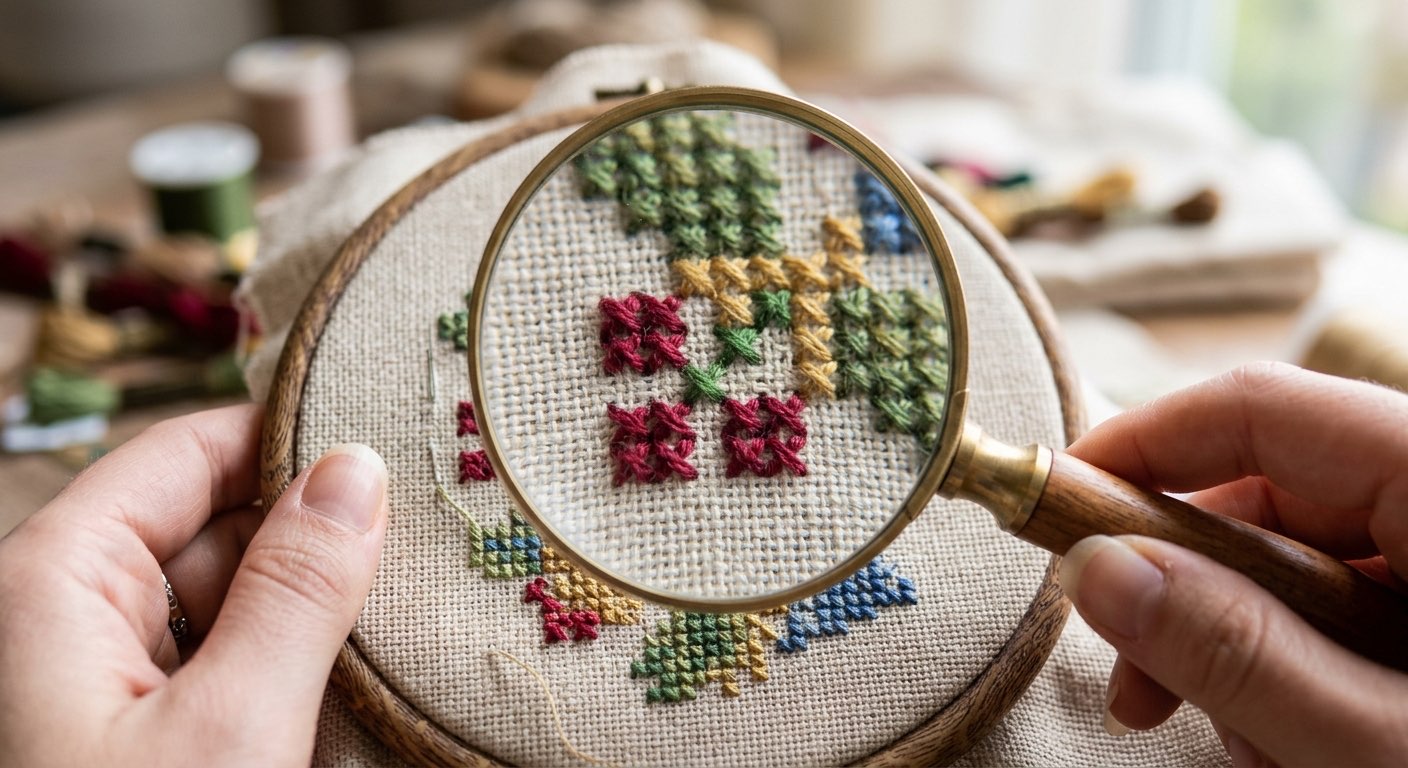
You don’t need to spend $100+ to get a functional setup. The Carson DeskBrite mentioned above is the best sub-$40 option. If you’re willing to go slightly higher, the Fancii clip-on lamps in the $30–45 range are genuinely good for what they are.
The one place I’d caution against going too cheap: the lens. Low-quality acrylic lenses introduce distortion at the edges that makes fine-count work genuinely harder. A $20 lamp with a bad lens can cause more eye strain than no magnification at all.
If budget is the main constraint, a decent daylight LED desk lamp paired with inexpensive clip-on reading glasses (+2.00 to +2.50 diopter) is a legitimate alternative that many stitchers swear by. Less elegant, but functional.
Browse daylight desk lamps on Amazon
Ergonomic Tips for Long Stitching Sessions
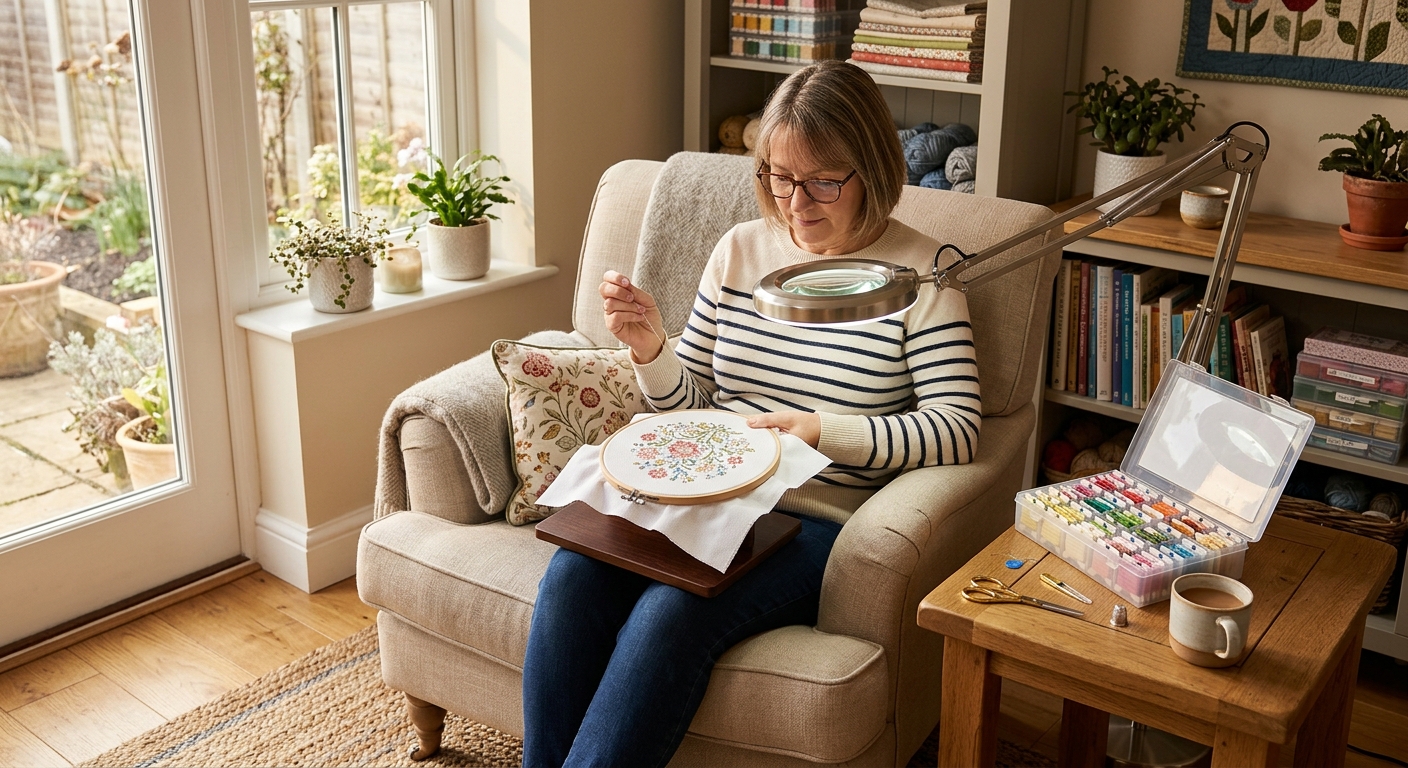
Good lighting is part of the ergonomic picture, not all of it. A few other things that make a real difference:
Position the light source to eliminate glare. The lamp should be to the side of your dominant hand, not directly above. Overhead lighting creates shadows from your needle hand.
Give your eyes a break. Every 20 minutes or so, look at something across the room for 20 seconds. It sounds fussy but it genuinely reduces fatigue during long sessions.
Match your magnification to your fabric count, not your age. Younger stitchers working 28-count need magnification as much as older stitchers working 14-count. It’s about the thread size, not just vision.
Don’t lean in to compensate for bad light. If you find yourself hunching over the work, that’s usually a sign the lighting isn’t adequate — not a sign you need to get closer. Better light lets you sit up and hold the hoop at a comfortable distance.
Good lighting also matters when working with dark colors that are close in value — threads like DMC 500 Very Dark Blue Green and DMC 310 Black can look nearly identical under warm light but are clearly distinguishable under proper daylight LEDs. The same goes for the blues family, where subtle shade differences are critical to getting gradients right.
If you’re putting together a full stitching setup and want more on organizing your thread stash and keeping conversions straight, the color categories section has reference pages for every major brand comparison.
Disclosure: This post contains affiliate links. We may earn a small commission at no cost to you when you purchase through these links. This helps support the site and allows us to continue creating free content.