Cross-Stitch vs Embroidery: What's the Difference?
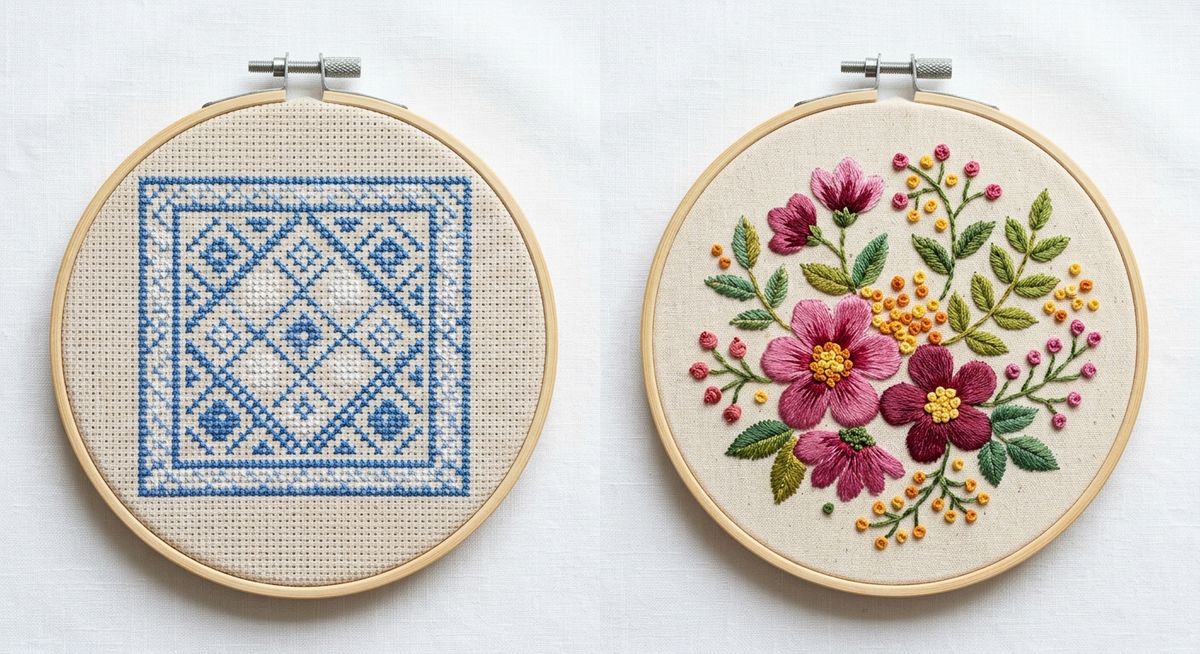
Cross-stitch and embroidery are two of the most commonly confused terms in the fiber arts world, and the confusion is understandable. They use the same thread. They use the same fabric in many cases. They’re sold in adjacent aisles in craft stores, and the kits are packaged to look nearly identical. Stitchers do both. Some stitchers barely distinguish between them.
But they are different things, and understanding the difference helps you figure out which one you’re actually interested in — and which skills transfer between them.
The Quick Answer
Embroidery is the broad category. It’s any decorative needlework that uses thread to embellish fabric. Cross-stitch is one specific type of embroidery stitch — and when people say “cross-stitch” as a hobby, they usually mean a specific style of embroidery built around that one stitch and the counted grid system it uses.
Think of it this way: all squares are rectangles, but not all rectangles are squares. All cross-stitch is embroidery, but not all embroidery is cross-stitch.
What Is Embroidery?
Embroidery encompasses an enormous range of techniques, all of which involve using needle and thread to add decorative elements to fabric. The major categories include:
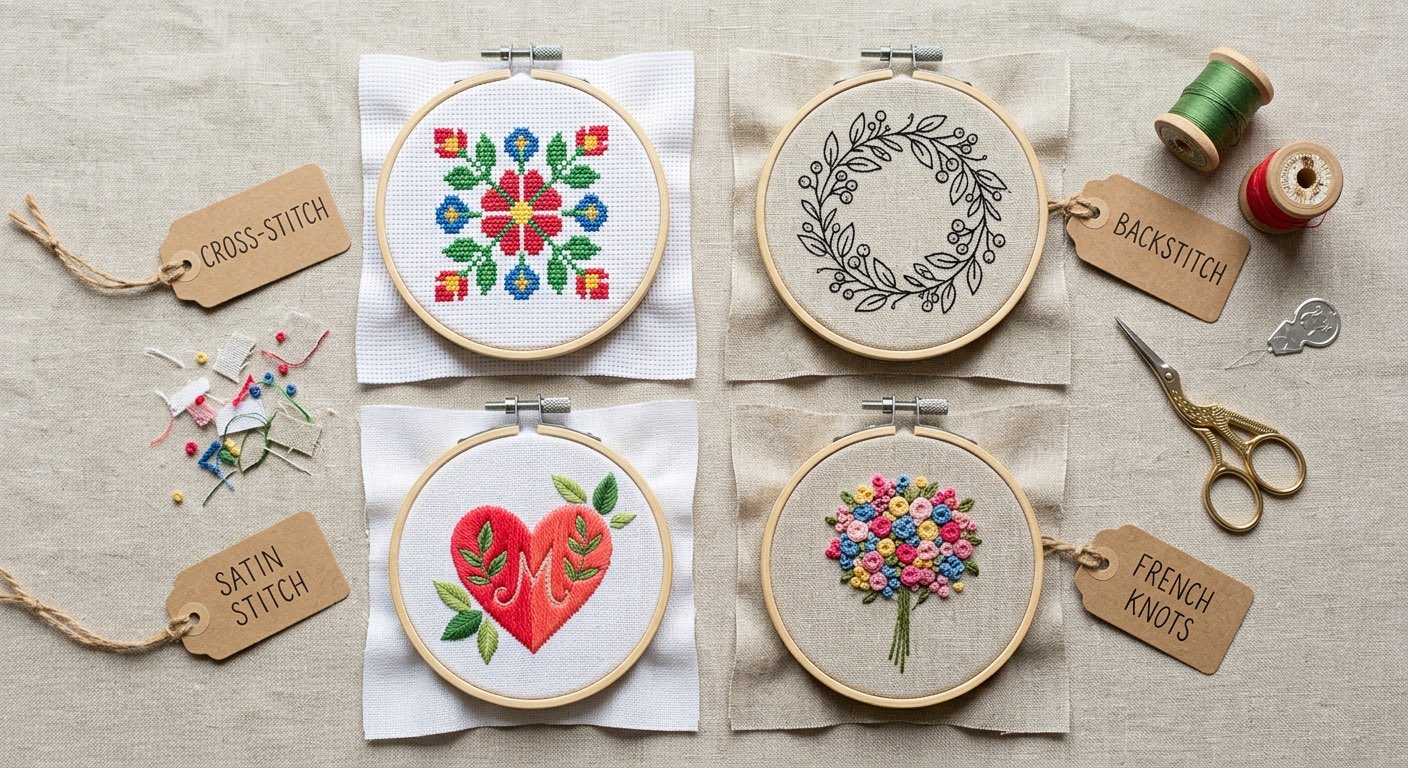
Surface embroidery — stitching directly on fabric using techniques like satin stitch, stem stitch, chain stitch, French knots, lazy daisy, couching, and dozens of others. This is what most people picture when they think of “freestyle” embroidery: pictorial and floral designs, often on linen or cotton, where the stitcher has significant creative freedom in how they build up color and texture.
Counted embroidery — working from a grid chart to place stitches precisely on evenweave or Aida fabric. Cross-stitch is the most common form of counted embroidery, but so is hardanger, blackwork, and certain styles of needlepoint.
Canvas work / Needlepoint — stitching on stiff canvas with wool or cotton, filling in sections with tent stitch, basketweave, or other canvas stitches. Often used for upholstery, belts, and decorative panels.
Crewel embroidery — surface embroidery worked with wool thread on linen, creating a soft, dimensional result. Traditional English crewel designs often feature botanical and animal motifs in an elevated, painterly style.
Goldwork — embroidery using metallic threads and wire forms, traditional in ecclesiastical and ceremonial contexts. Highly technical, extremely slow, and produces results that nothing else replicates.
So when someone says “I do embroidery,” you actually don’t know very much about what they do until you ask a follow-up question.
What Is Cross-Stitch?
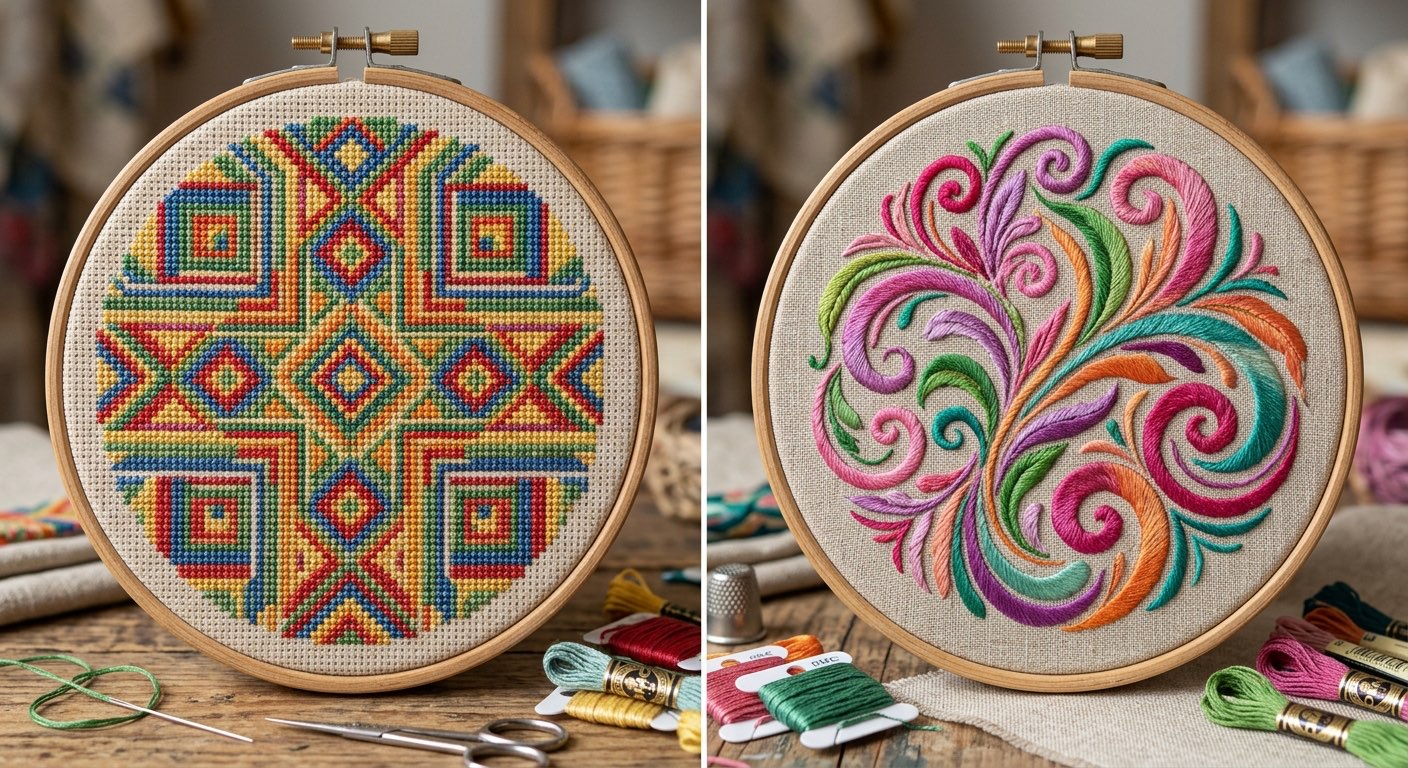
Cross-stitch is a specific stitch — two diagonal stitches forming an X — worked on a counted grid to build up pixelated designs. When stitchers talk about “cross-stitch” as a hobby, they almost always mean:
- Working from a chart (a grid where each square represents one stitch)
- On Aida fabric or evenweave linen
- Using DMC or Anchor embroidery floss
- Creating designs by placing X-stitches in a grid system
The stitch itself is ancient and appears in historical needlework across cultures worldwide. The modern hobby as practiced in the US and UK — following counted charts, using commercial thread with standardized numbering, buying patterns from designers — dates from the late 19th century and accelerated significantly with the rise of kit stitching in the 20th century.
The key distinction from freestyle embroidery is the grid system. Cross-stitch is inherently pixel-based: each stitch lives in a specific location in a regular grid, and designs are built from those discrete units. There is much less room for spontaneous creative decision-making during the actual stitching — you follow the chart. The creative decisions happen at the design and pattern selection stage.
How the Two Relate: Where They Overlap
The confusion is honest, because the two crafts share almost all of their materials and much of their technique.
Shared materials: Both typically use six-strand embroidery floss (DMC being the dominant brand in both communities). The same thread, used in the same needle, on the same type of fabric. A skein of DMC 321 Christmas Red is equally at home in a counted cross-stitch Christmas pattern and a freestyle embroidery piece featuring a cardinal.
Shared tools: Tapestry needles for counted work, crewel or embroidery needles for surface work — both in the same size ranges, from the same makers. Hoops, Q-snaps, and scroll frames are used in both disciplines.
Backstitch appears in both: Cross-stitch pieces regularly include backstitch for outlines, lettering, and detail lines. Freestyle embroidery uses stem stitch, backstitch, split stitch, and chain stitch for linear elements. These stitches are closely related and the skills transfer directly.
Many stitchers do both: Someone who started with cross-stitch often ventures into surface embroidery after a few years and brings the thread knowledge and fabric knowledge with them. The learning curve for the new discipline is lower because so much foundation is shared.
The Key Differences
Creative Freedom
Freestyle embroidery is significantly more freeform. You can stitch in any direction, build up dimension through layered stitches, vary stitch size and angle to suggest texture and light, and make decisions on the fly. A skilled embroiderer painting a rose in satin stitch is making hundreds of micro-decisions about angle, length, color placement, and coverage as they go.
Cross-stitch is comparatively constrained. The chart tells you what goes where. You count, you stitch, you count again. The creativity lies in pattern selection, color choices, and fabric choice — not in the moment-to-moment placement of stitches. Some stitchers love this predictability; it’s meditative in a way that freestyle work is not.
Fabric
Cross-stitch almost always uses Aida or evenweave linen — fabrics with a regular, countable grid. The grid is what makes counted embroidery possible.
Freestyle embroidery can be worked on almost any fabric: quilting cotton, denim, velvet, felt, even leather. The fabric choice is part of the creative decision.
Skill Progression
Cross-stitch has a relatively low floor. Most beginners produce passable results within their first project. The fundamental skill — making consistent X-stitches on a grid — is not technically difficult. Advanced techniques (tent stitch variations, fractional stitches on linen, railroading, working on high-count evenweave) take time to master, but they’re extensions of the same basic skill.
Freestyle embroidery has a wider skill range. Beginner surface embroidery — a simple flower in satin stitch, a stem in stem stitch — is accessible. But the ceiling is much higher. Thread painting (creating realistic shaded illustrations purely through careful stitch placement) and goldwork are genuinely difficult techniques that take years to develop. The skill ladder is longer.
Pattern Availability and Cost
Cross-stitch pattern design has exploded in the last decade. There are thousands of free patterns online, hundreds of independent designers selling affordable PDF charts, and every subject imaginable — from pixel art to realistic portraits to licensed pop culture designs — is available.
Freestyle embroidery patterns exist in abundance too, but they tend to be more style-specific and some of the best independent designers in surface embroidery charge more for patterns that represent higher design work. There’s also a stronger tradition of working from original drawings rather than purchased patterns in surface embroidery.
The Thread Is the Same — The Conversions Matter Regardless
One thing that matters equally for both crafts: if you’re working from patterns that specify thread brands, and you want to substitute a different brand, you need accurate conversion data.
A cross-stitch pattern specifying DMC 310 Black and a freestyle embroidery pattern specifying the same number are both assuming you’ll use that specific color — and if your local shop is out of it, you need to know whether Anchor 403 or Madeira’s equivalent is a near-exact match or just close. That matters whether you’re filling a grid square or covering a satin-stitched petal.
Our color conversion pages cover the full DMC range with Anchor, Madeira, Cosmo, and Sullivans equivalents — useful for both disciplines equally.
Which Should You Start With?
This depends entirely on what draws you to the craft.
Start with cross-stitch if:
- You like the idea of following a chart and producing predictable results
- You’re drawn to the pixel-art, graphic quality of counted work
- You want to start and be competent quickly
- You like the meditative quality of repetitive, structured work
- Fan art, pop culture designs, or geometric patterns appeal to you
Start with freestyle embroidery if:
- You want to paint with thread — create shaded, dimensional, realistic images
- You’re drawn to botanical and floral work
- You want more creative control during the stitching process
- You’re comfortable with a longer learning curve before producing polished results
- You want to eventually work on surfaces other than Aida fabric
If you genuinely can’t decide: Start with a cross-stitch kit. The learning curve is shorter, you’ll finish something satisfying within weeks, and you’ll have enough context to make a more informed decision about whether to stay in cross-stitch, venture into surface embroidery, or do both. Our beginner kit guide covers what to look for and what to avoid in a first kit.
A Note on Stamped Embroidery
There’s a category that sits somewhat between the two: stamped cross-stitch and stamped embroidery, where the design is pre-printed on the fabric.
Stamped embroidery kits are often sold at hobby stores with bold floral or bird designs pre-printed on cotton or linen. You fill in the printed lines with various stitches. This has less in common with true freestyle embroidery than it appears — the design decisions have been made for you, and you’re essentially coloring within lines using thread.
It’s a legitimate entry point to the craft, lower frustration than trying to learn counted work and stitch reading simultaneously. But it teaches a somewhat limited skill set — you won’t learn to read charts, and you won’t build the grid-reading ability that makes true counted work possible.
Stamped embroidery is fine as a starting point. Just know what it is and what it isn’t before committing to a style.
Do You Have to Choose?
No. Many stitchers occupy both worlds and move between them by project.
Someone might spend most of their stitching time on large counted cross-stitch pieces — following a complex chart, managing dozens of colors, working toward a finish that might take a year — and also have a small surface embroidery hoop on the go for the evenings when they want something free and fast with no counting involved.
The skills genuinely complement each other. Cross-stitch builds precision and patience. Surface embroidery builds an eye for tone, texture, and creative decision-making in the moment. Stitchers who do both tend to be better at both.
There are enough years and enough evenings to try everything.
Disclosure: This post contains affiliate links. We may earn a small commission at no cost to you when you purchase through these links. This helps support the site and allows us to continue creating free content.