The 10 Best Cross-Stitch Supplies Every Stitcher Needs
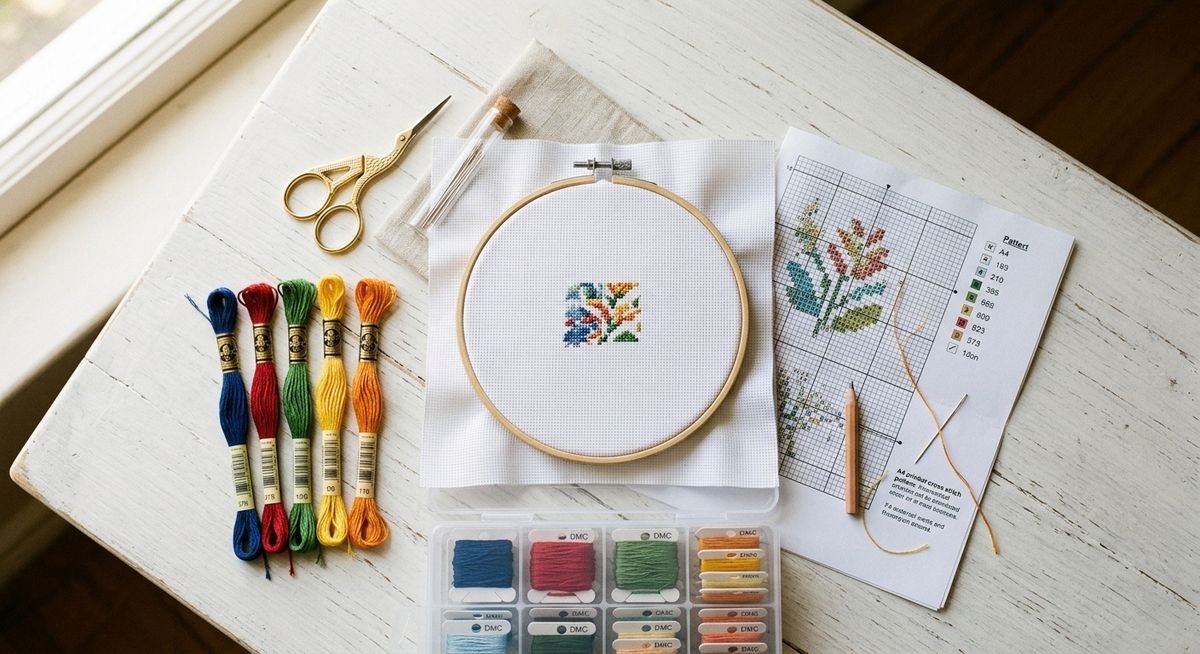
There’s a version of this hobby where you spend $200 before you’ve made a single stitch, chasing gear you don’t understand yet. And there’s a version where you start with a sewing needle and printer paper and wonder why it isn’t working. The truth is somewhere in between: a handful of specific supplies make a real and measurable difference. Everything else is optional.
This guide covers the ten things that are actually worth buying — and what to look for in each one. Whether you’re setting up your first kit or filling gaps in a stash that grew faster than you expected, this is the honest list.
Quick Reference
| Supply | Price Range | Priority |
|---|---|---|
| Tapestry needles (size 24–26) | $4–$12 | Essential |
| 14-count Aida fabric | $8–$25 | Essential |
| Embroidery hoop (6-inch) | $6–$18 | Essential |
| Thread organizer | $12–$35 | High |
| Small sharp scissors | $8–$25 | Essential |
| Pattern (digital or printed) | Free–$15 | Essential |
| Thread — DMC starter set | $20–$55 | High |
| Magnifying lamp | $30–$120 | High |
| Needle threader | $4–$15 | Helpful |
| Project bag or organizer | $15–$45 | Recommended |
1. Tapestry Needles (Size 24–26)
The first mistake many beginners make is reaching for a regular sewing needle. It won’t work — or rather, it’ll technically work and feel like a frustrating fight the entire time. Cross-stitch uses tapestry needles: blunt-tipped needles with an elongated eye large enough to thread embroidery floss without forcing it. The blunt tip slides through the weave of Aida fabric rather than splitting it.
Sizes 24 and 26 are the standard range for 14-count Aida. Size 24 is slightly easier to thread; size 26 fits more smoothly through smaller fabric counts. If you’re working on 14-count with two strands of DMC, size 24 is the right choice. If you ever move to 18-count or higher, size 26 becomes essential.
What to look for: Nickel-plated or gold-plated needles last longer and resist corrosion from the natural oils on your hands. Cheap needles from unknown brands can have rough eyes that fray your thread with every stitch. A pack of 6–10 quality needles is more useful than a 50-pack of poor-quality ones.
Pros:
- Blunt tip prevents fabric damage
- Large eye makes threading six-strand floss manageable
- Correct size gives clean, consistent stitch tension
Cons:
- None, really — just don’t use sewing needles
Price range: $4–$12 for a pack of 6–10
Shop tapestry needles for cross-stitch on Amazon
2. 14-Count Aida Fabric
Aida fabric is the woven canvas that makes counted cross-stitch possible. It has a regular, gridded structure — evenly spaced holes separated by woven “blocks” — that lets you place every stitch in exactly the right position relative to the ones around it. The “count” refers to the number of stitches per inch: 14-count means 14 stitches fit in one inch.
For beginners, 14-count is the right place to start. The holes are large enough to see and hit without magnification, but small enough that a finished piece looks neat and detailed at normal framing distances. The overwhelming majority of published cross-stitch patterns are designed for 14-count. It’s the industry default for good reason.
For a thorough breakdown of all the count options, the differences between brands, and how to choose between white and cream fabric, read our Aida fabric counts guide. The short version: white for high-contrast designs with a lot of dark stitching, cream for anything with a vintage or botanical aesthetic. Both are correct — just different.
DMC and Charles Craft are reliable brands at everyday prices. Zweigart is the premium option for pieces you’re keeping or gifting. For a practice project or your first few pieces, any major brand at 14-count white will serve you well.
Price range: $8–$25 depending on brand and yardage
Shop 14-count Aida fabric on Amazon
3. An Embroidery Hoop
Stitching without a hoop produces uneven tension — the fabric puckers and pulls, stitches look inconsistent, and the finished piece lies flat only under pressure. A hoop keeps the fabric taut and lets the needle move freely without dragging the weave out of alignment. It’s not optional.
Plastic vs. bamboo: This is the question beginners ask most, and the answer is genuinely split.
Bamboo hoops are traditional, inexpensive, and pleasant to hold. They grip fabric well and look nice. The downsides: the inner and outer rings can get slightly out of round over time, which makes the screw grip uneven. They can also leave hoop marks on fabric if you store a project in the hoop long-term.
Plastic hoops — particularly the Morgan No-Slip Hoop and similar designs with a lip rather than a screw — grip fabric more evenly and don’t mark it. They’re also more resistant to warping. The tradeoff is that some stitchers find them less comfortable to hold for long sessions.
For a first hoop: a 6-inch bamboo hoop is the right starting place. It’s large enough for a beginner project, small enough to be manageable, and costs very little. Once you know you love the hobby, a quality plastic or Morgan-style hoop is a worthwhile upgrade.
Pros of 6-inch for beginners:
- Holds a full beginner project
- Light and comfortable to hold for extended sessions
- Easy to reposition on the fabric as you work
Cons:
- Fabric extends beyond the hoop — keep it clean and away from pets
Price range: $6–$18
Shop 6-inch embroidery hoops on Amazon
4. A Thread Organizer
The first time you reach into a bag and pull out a tangled knot of six different colors, you’ll understand why this category exists. Thread organization isn’t optional once your stash grows beyond a single project’s worth of colors — and it doesn’t take long to get there.
The two systems that work best for most stitchers:
Plastic bobbin boxes: Wind floss onto bobbins, label with the DMC number, slot into compartments. Cheap, fast to set up, easy to see colors at a glance. A good starting system. Scales poorly past 100 colors but is perfect for the first year or two.
Floss-A-Way bag systems: Each color gets a small labeled zip bag on a ring. No tangling, scales infinitely, easy to pull individual colors for a project kit. More setup time upfront, but the long-term system of choice for serious stitchers.
For a detailed comparison of every major system — including thread racks, binders, and DMC’s own storage cabinet — read our full embroidery floss organizers guide. It covers what works at every stash size.
Price range: $12–$35 for a starter setup
Shop embroidery floss organizer boxes on Amazon
5. Small Sharp Scissors
Cross-stitch scissors serve two specific purposes: cutting thread cleanly at the start of a length, and snipping thread close to the fabric when finishing off. For both jobs, you need scissors with fine, pointed tips — not the blunt-nosed school scissors that come in a lot of beginner kits.
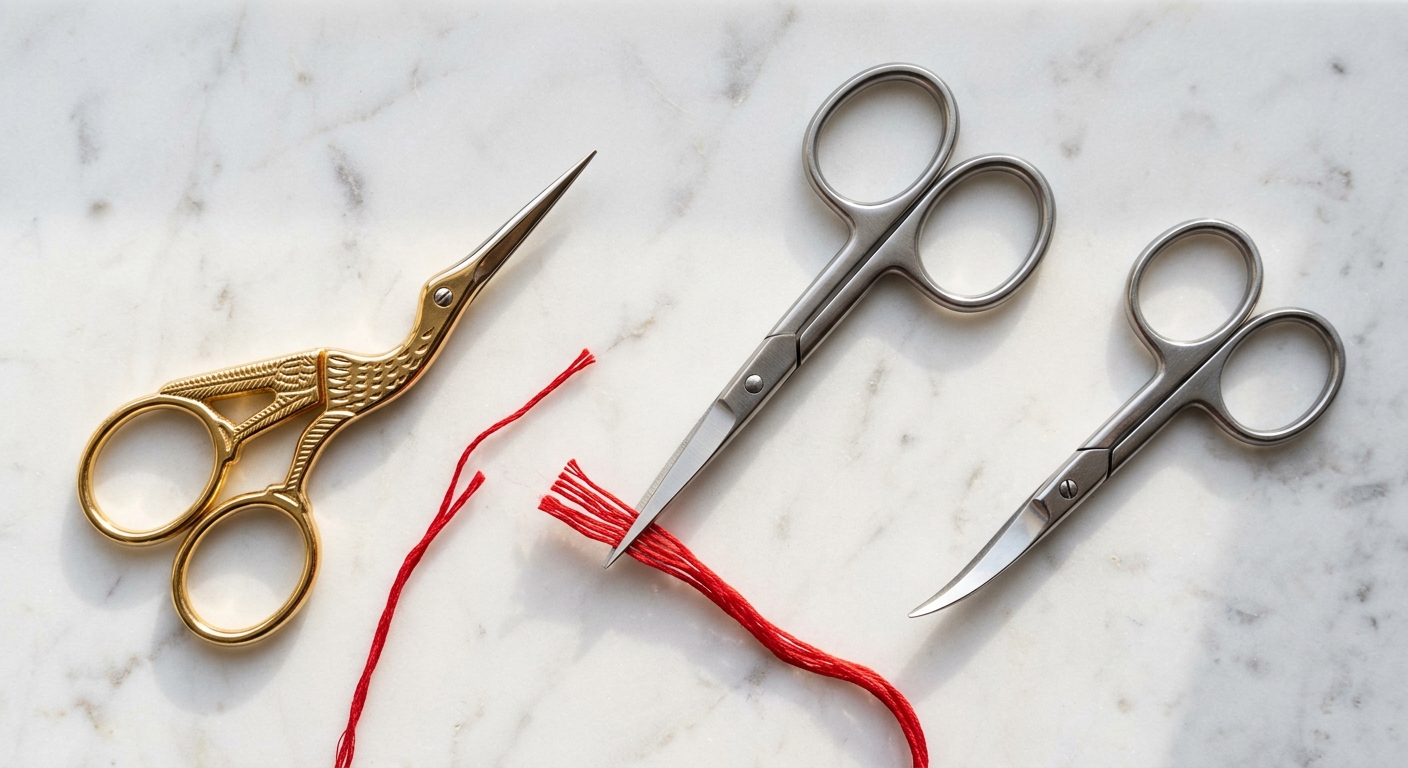
Dedicated embroidery scissors are small — typically 3.5 to 4.5 inches long — with sharp, narrow blades that meet precisely at the tip. This lets you snip a thread flush with the fabric surface without accidentally cutting something nearby. Full-size scissors make this nearly impossible without constant micro-adjustments.
What matters most: tip sharpness and blade alignment. Both blades need to meet cleanly all the way to the point. Hold them up and look at the tips before buying — if there’s a gap, the scissors will shred thread rather than cut it cleanly.
Stork scissors — the ornate curved-handle style that’s been popular in needlework for over a century — are the most visually distinctive option and a traditional gift for stitchers. They’re not just decorative; the curved handle makes them comfortable for the specific motion of cutting thread at an angle. There are genuine antique versions and modern reproductions; the modern ones from reputable brands (Gingher, Wasa) are solid choices.
For workspace setup context — including how good lighting helps you see where you’re cutting on dark fabric — check our magnifying lamps guide.
Price range: $8–$25
Shop small sharp embroidery scissors on Amazon
6. A Good Pattern
Every other supply on this list is just infrastructure. The pattern is the actual project.
For beginners, good options include:
- Kits (see our best beginner kits guide) — fabric, thread, pattern, and needle in one package
- Free patterns online — many reputable designers offer simple beginner patterns for free
- Small purchased designs from independent designers on Etsy or Ravelry, typically $3–$8
When you’re choosing a first pattern, size matters more than aesthetics. A design that finishes in 3–4 weeks of casual stitching gives you a completed piece you can frame. A design that takes six months might still be a WIP two years later.
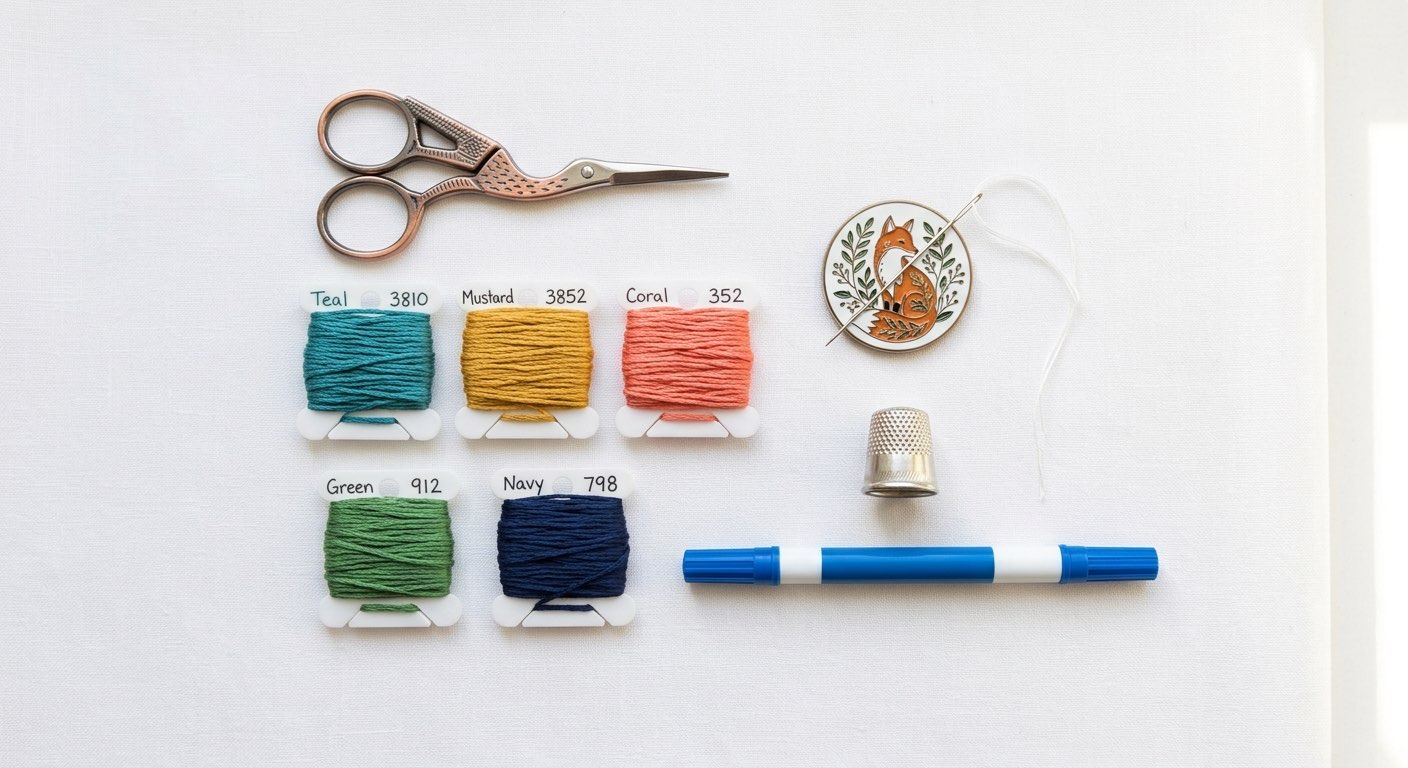
The other thing patterns reveal quickly: whether you need to convert thread colors. A pattern might specify DMC 310 Black for outlines and DMC 321 Christmas Red as the primary color, but your local shop only stocks Anchor. That’s where our color search tool and brand conversion pages come in. You can look up any DMC color — including popular ones like DMC 666 Bright Red, DMC 3750 Very Dark Antique Blue, or DMC 699 Christmas Green — and find the closest equivalent across Anchor, Madeira, Cosmo, and Sullivans instantly.
If you’re building out a palette rather than following a specific pattern, our color family pages are a useful browsing tool — particularly the reds, blues, and greens families, which cover the most commonly used colors in most beginner projects.
Price range: Free–$15
7. Thread — Start with a DMC Starter Set
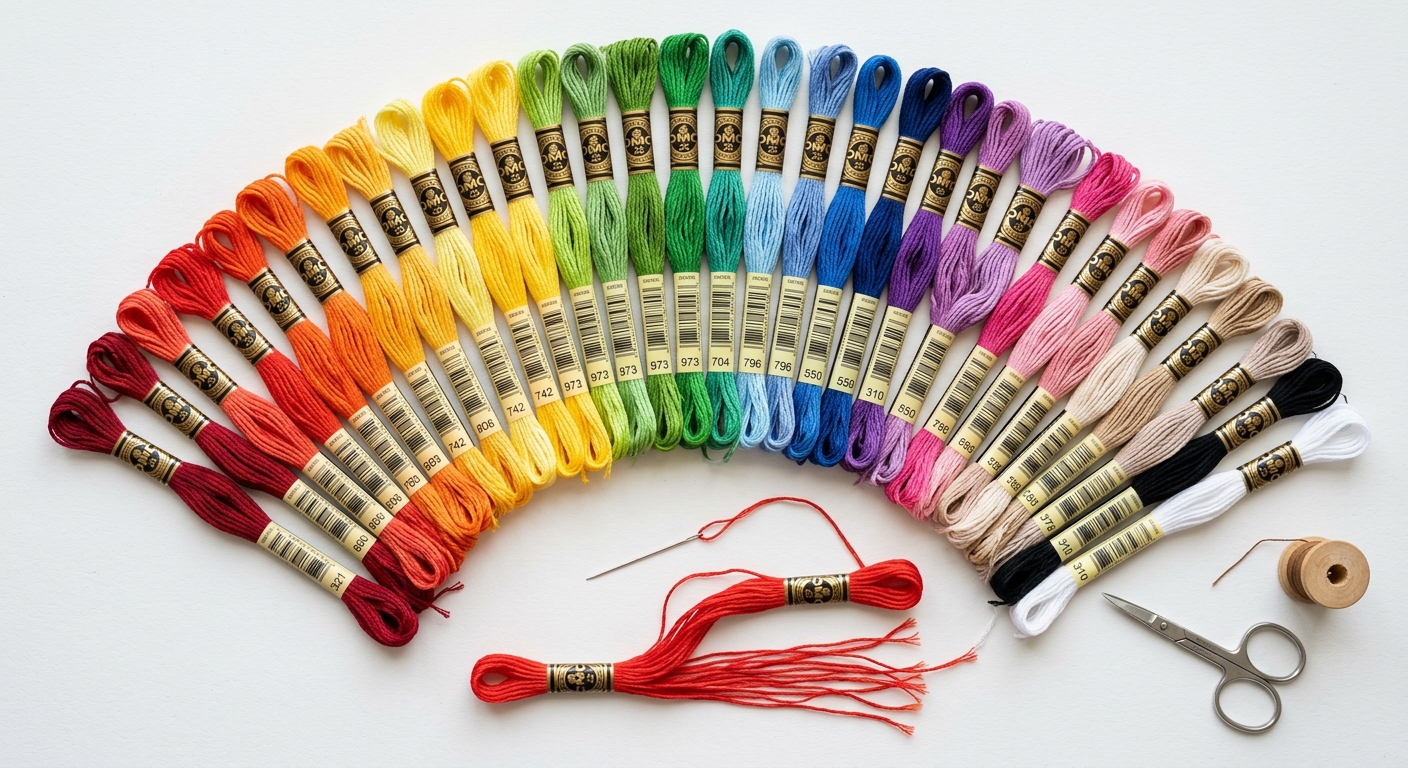
DMC is the world’s most widely used embroidery floss brand, and the one that most patterns reference by default. The thread is consistently good: colorfast, tightly twisted, available in over 500 colors, and sold virtually everywhere. For most stitchers, DMC is the default, and it’s a sensible place to start.
Buying individual skeins is the most economical approach once you know which colors you need. But for a first stash, a starter set — typically 36 to 100 pre-selected colors covering the most common palette range — removes the paralysis of choosing from 500 options.
The DMC 36-color starter set is the most common entry point. It covers primary colors, neutrals, a range of warm and cool tones, and includes DMC 310 Black (the universal backstitch color and one of the most-used threads in the entire catalog) and DMC 3865 Winter White. Once you’ve worked through a few projects, you’ll know which families you need more of and can fill in from there.
A few colors worth adding early regardless of your pattern:
- DMC 310 Black — outline and backstitch workhorse, used in nearly every design
- DMC 321 Christmas Red — classic bold red, frequent in seasonal designs
- DMC 796 Dark Royal Blue — versatile mid-dark blue that appears constantly
- DMC 433 Medium Brown — the invisible essential brown for earth tones, hair, and wood
When a pattern calls for a color you don’t have, check the DMC to Anchor conversion pages to find a working substitute before buying a new skein. In many cases, a thread already in your stash will be close enough for the project at hand.
Price range: $20–$55 for a starter set
Shop DMC embroidery floss starter sets on Amazon
8. A Magnifying Lamp
This one has a wider impact than most beginners expect, and it’s the supply people most frequently say they wish they’d bought earlier.
Good lighting does two things: it makes the holes in your fabric easier to see (reducing threading errors and miscounts), and it renders thread colors accurately. Bad light — especially warm yellow light from incandescent bulbs or older LEDs — washes out color distinctions that matter. Two shades that look clearly different in daylight can look nearly identical under a warm lamp. That’s a problem when you’re trying to distinguish DMC 930 Dark Antique Blue from DMC 336 Navy Blue, or checking whether a thread matches a conversion suggestion.
Daylight-balanced LEDs (5000–6500K color temperature) are what you want. They render colors accurately and don’t cause the eye strain that extended work under warm light produces.
For a full breakdown of every category — floor lamps, desk lamps, clip-ons, and what to look for in magnification and color temperature — read our magnifying lamps for cross-stitch guide. The short recommendation: the Brightech LightView Pro for floor use, or a clip-on daylight LED for travel and portability.
If budget is the constraint, a daylight LED desk lamp paired with inexpensive clip-on reading glasses is a legitimate workaround many stitchers use.
Price range: $30–$120
Shop magnifying lamps for needlework on Amazon
9. A Needle Threader
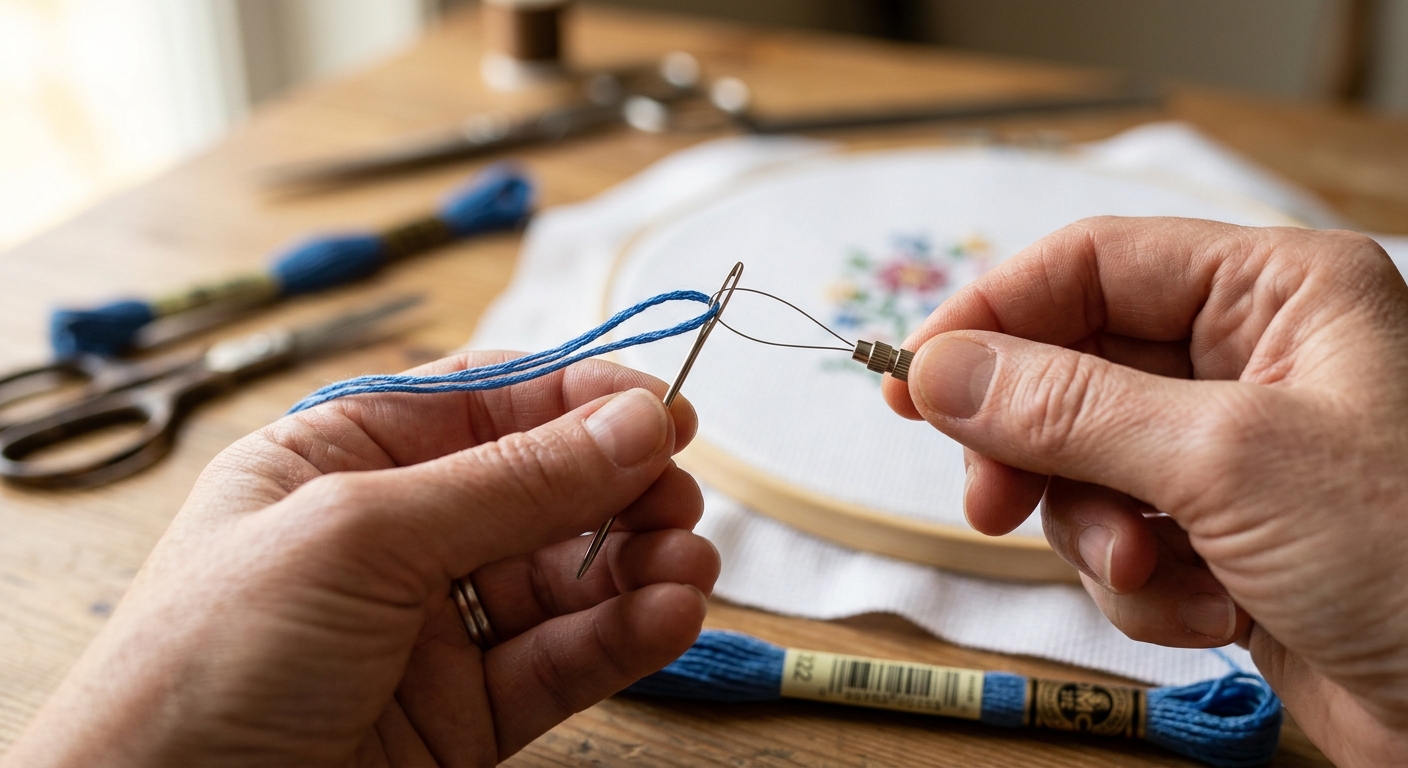
Threading a tapestry needle with embroidery floss sounds simple until you’re fumbling with two slippery strands under bad light after a long day. A needle threader takes a 20-second frustration to a two-second mechanical operation.
The classic wire loop threaders — the ones with a thin metal diamond on a stamped metal handle that have been sold for $1 at every craft store for decades — technically work and break within a month. They’re worth having as emergency backups, but not as a primary tool.
Better options:
Clover Desk Needle Threader: A weighted, freestanding device that threads needles (and holds them) while leaving both hands free to manage the floss. Genuinely useful for bulk threading sessions or anyone with limited fine motor control.
Loop threaders (floss threaders): A flexible plastic loop on a rigid handle. You pass the loop through the needle eye, thread the floss through the loop, pull back through. More reliable than wire loop threaders and gentler on thin needle eyes.
Self-threading (calyx-eyed) needles: Needles with a small V-notch at the top of the eye rather than a closed hole — you press the thread down into the notch rather than threading it through. Extremely fast. The tradeoff is they’re not available in every size and the notch can occasionally snag thread.
Pros of any needle threader:
- Saves time and frustration
- Essential when working with specialty threads or metallic floss
- Helpful for anyone with vision or dexterity challenges
Price range: $4–$15
Shop needle threaders for cross-stitch on Amazon
10. A Project Bag or Organizer
Cross-stitch is a portable hobby — one of its genuine advantages over larger crafts. But portability only works if you have a way to carry your current project, its pattern, the relevant thread colors, and your scissors without everything tangling or getting lost. A project bag solves this.
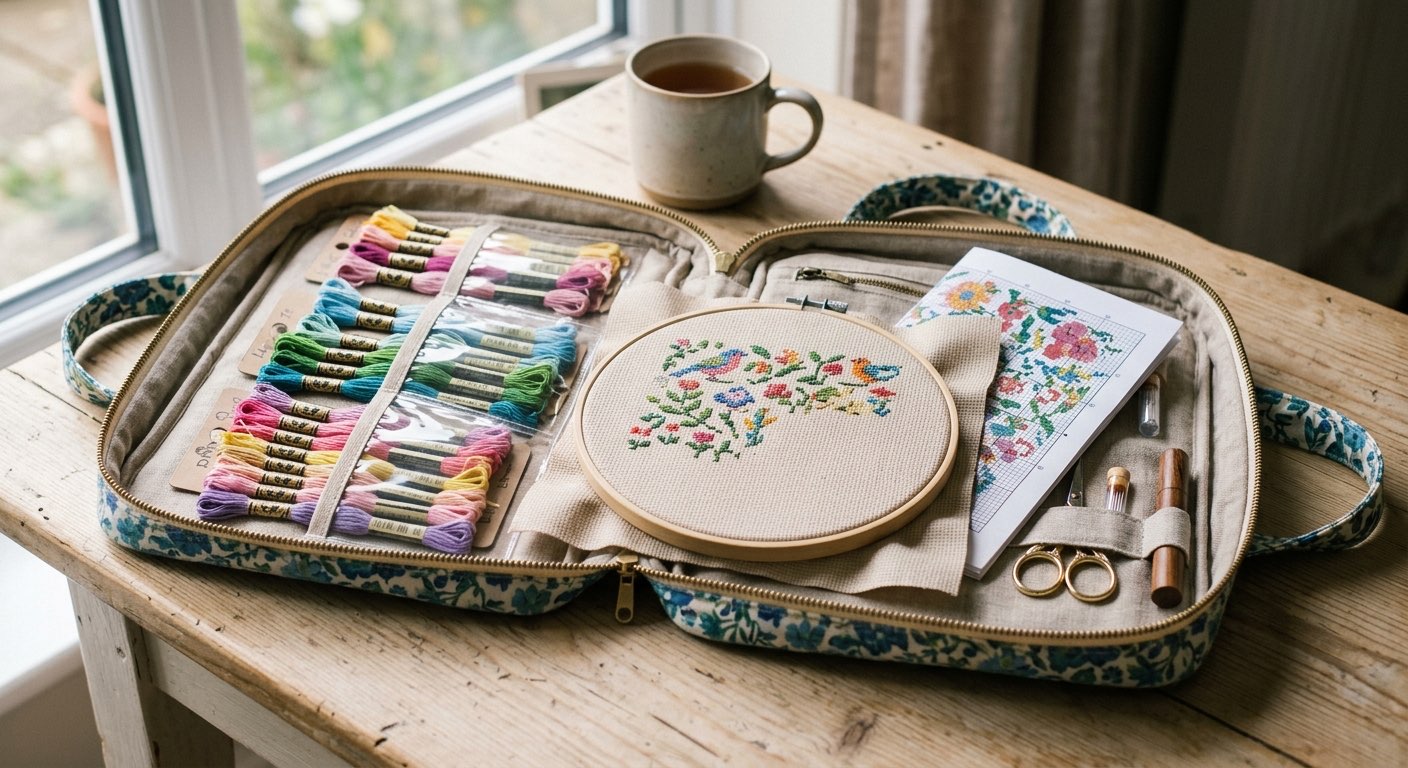
This isn’t the same as a stash organizer. Your stash lives at home in whatever system works for your collection. A project bag is specifically for the active piece you’re working on: the hoop or Q-snap, the fabric, a small zip bag with the colors you need for this project, your scissors, and the pattern or a printed section of it.
What makes a good project bag:
- Multiple compartments — at least one large enough for a 6-inch hoop
- A zip closure that won’t pop open in a tote or backpack
- Internal pockets for scissors, needles, and small items
- Hard enough structure to protect the hoop from being crushed
- Handles plus a shoulder strap if you take it on the go
Canvas zip totes with inner pockets work well and are inexpensive. Dedicated needlework project bags from brands like Lantern Moon, Creative Needle, and Sew Easy are purpose-built and typically more durable, but at a higher price. The Lantern Moon tote bags are consistently recommended in needlework communities for quality and practicality.
For most stitchers, the project bag is the last piece of the organization puzzle. Your main stash lives in a thread box or binder system (see the organizers guide), and your active project lives in this bag.
Pros:
- Keeps projects portable and ready to grab
- Protects fabric from dust, pet hair, and spills
- Consolidates everything for a project in one place
Cons:
- Easy to accumulate too many half-organized project bags (the craft equivalent of browser tabs)
Price range: $15–$45
Shop needlework project bags on Amazon
Putting It Together: The Practical Starter Kit
If you’re starting from scratch and want to know what to buy first, here’s a sensible ordering:
Buy immediately:
- A pack of size 24 tapestry needles ($5–$8)
- One piece of 14-count white Aida, at least 12x12 inches ($8–$12)
- A 6-inch bamboo hoop ($4–$8)
- A small set of DMC colors — either a starter pack or 10–15 individual skeins of colors your pattern calls for
- Small sharp embroidery scissors ($10–$15)
Total: roughly $30–$50 before you’ve bought a pattern.
Add when you’re ready:
- A magnifying lamp — as soon as eye strain becomes an issue, which is usually after the first project
- A thread organizer — once you have more than one project’s worth of thread
- A project bag — once you want to take stitching out of the house
Nice to have eventually:
- A needle threader
- Multiple hoop sizes (4-inch for small pieces, 8 or 10-inch for large projects)
- Q-snap frames for large full-coverage pieces
A Note on Pattern Colors and Conversions
One thing you’ll encounter quickly when buying supplies independently: the thread colors your pattern lists may not be the thread you can find locally. Patterns reference DMC numbers by default; your local shop may carry Anchor, Madeira, or Cosmo instead.
That’s exactly the problem our color conversion pages solve. You can look up any DMC color and immediately see its closest equivalent in every major brand. The DMC 310 to Anchor conversion page is a good example — it shows the match quality, the Anchor number, and notes any significant color differences. Every major DMC color has its own conversion page across all the brands we cover.
If you’re building a palette from scratch rather than following a specific pattern, our color search tool lets you browse by color family, find related shades, and see all available brand equivalents in one place. It’s the fastest way to find what you need when you’re standing in a shop with a specific color in mind but the wrong brand on the shelf.
Final Thoughts
Cross-stitch has a low barrier to entry if you buy the right things at the start and a surprisingly high one if you don’t. The supplies on this list aren’t about spending money — they’re about removing the specific friction points that make the hobby feel harder than it actually is.
Get the right needles. Use real Aida. Work in good light. Keep your thread organized. Everything else is refinement.
Happy stitching — and may your thread never tangle.
Disclosure: This post contains affiliate links. We may earn a small commission at no cost to you when you purchase through these links. This helps support the site and allows us to continue creating free content.