
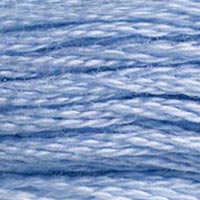
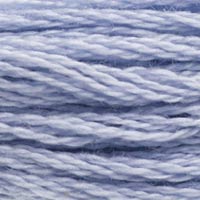
DMC 157 — Very Light Cornflower Blue
Blues family · Hex #BBC3D9
Quick Conversion Table
| Brand | Equivalent | Match |
|---|---|---|
| Anchor | 120 | close |
| Madeira | 0907 | close |
| Cosmo ⚠ | 149 | close |
| Sullivans | 45472 | close |
| J&P Coats | 7976 | close |
| Dimensions | 17005 | close |
The Psychology of Calm in a Single Shade
Color psychology research consistently identifies soft, desaturated blues as the most universally calming hues in the spectrum. Not bright blues (too stimulating), not dark blues (too heavy), but exactly the kind of muted, lavender-touched blue that DMC 157 embodies. Interior designers know this. Spa owners know this. And cross-stitch designers who specify 157 for baby blanket borders, meditation-themed samplers, and gentle landscape skies know this too — even if they're thinking in terms of aesthetic rightness rather than psychological research.
DMC 157, Very Light Cornflower Blue, occupies a fascinating position in the blue spectrum. It's blue, yes, but with enough violet undertone to soften it toward lavender without actually becoming purple. Hold it next to DMC 3325 (Light Baby Blue) and you'll see the difference immediately: 3325 is a clean, pure blue; 157 carries warmth, a faint suggestion of sunset reflected in still water. This violet lean makes it extraordinarily versatile in palettes that blend blues with purples and pinks — it bridges between those families naturally, smoothing transitions that would otherwise feel abrupt.
Working the Cornflower Family
The cornflower blue family in the DMC range — 157, 158 (Medium Very Dark Cornflower Blue), and 3807 (Cornflower Blue) — gives you a shading progression with a violet undertone that sets it apart from the standard blue families. Where the baby blue family (3756, 3325, 334, 322, 312) runs cool and clean, the cornflower series carries that distinctive warmth throughout, making the two families complementary rather than interchangeable.
As the lightest member of the cornflower group, 157 handles highlights and transition areas. It's the color of a cornflower petal where light hits it most directly, bleaching the blue toward white but retaining just enough color to read as blue rather than grey. In a shading sequence, stitch DMC 3807 for the deepest petal folds, DMC 158 for the mid-tones, and 157 for the highlights, and you get a convincing cornflower that captures the flower's particular blue — not the same as a delphinium blue or a chicory blue, but specifically, recognizably cornflower.
Outside of literal floral work, 157 excels as a background shade for designs that need color but not intensity. Baby announcement samplers, christening records, and nursery wall hangings often call for a background that says "peaceful" without shouting "blue." On white Aida, 157 provides a soft wash of color that doesn't overwhelm the main design elements. On cream or ecru fabric, it takes on an even gentler quality, the warm fabric and the warm-leaning blue harmonizing into something almost ethereal.
Stained Glass and Celestial Applications
Cathedral stained glass windows frequently include areas of pale blue glass — not the dramatic deep blues of the Virgin Mary's robes, but the lighter passages representing sky, water, or light itself. DMC 157 captures this specific shade of pale blue glass remarkably well, particularly when stitched alongside darker blues and outlined with DMC 310 or DMC 3799 (Very Dark Pewter Grey) in backstitch to simulate the lead cames that divide glass panels.
The violet undertone actually helps here, because real glass transmits light in complex ways that pure blue thread can't replicate. The slight warmth in 157 suggests the way filtered sunlight picks up ambient color as it passes through the glass, arriving on the cathedral floor as something richer than a flat blue. Pair it with DMC 3838 (Dark Lavender Blue) and DMC 791 (Very Dark Cornflower Blue) for a complete stained glass blue palette that captures both the depth and the luminosity of actual window glass.
For celestial designs — zodiac samplers, moon phase charts, star maps — 157 provides an excellent background option. It's light enough to allow white or cream stars and constellations to pop against it, yet colored enough to read unmistakably as sky. On 18-count or 28-count fabric, a full-coverage background in 157 creates a lovely field that feels like perpetual twilight: not quite day, not quite night, that suspended moment when the first stars become visible.
That Violet Lean Makes All the Difference
Here's where many substitutions for DMC 157 go wrong: stitchers reach for any light blue and assume it'll work. It won't — or at least, not in contexts where 157 is doing specific color-bridging work between blues and purples. Anchor 120 is a close match that respects the violet undertone, making it the substitute I'd try first. The slight sheen difference between DMC and Anchor threads won't be noticeable at this light value.
Madeira 0907 captures the cornflower quality and sits comfortably in the same tonal space. Cosmo 149 is worth testing but may lean slightly cooler — less violet, more pure blue — which could matter in a palette that relies on 157 to bridge between blue and purple elements. Sullivans 45472 gets you in the general area.
Within the DMC range, DMC 341 (Light Blue Violet) is temptingly close but shifts further into purple territory than 157 — it reads as a light violet with blue tendencies rather than a light blue with violet tendencies. That distinction matters enormously in a shading sequence. DMC 3747 (Very Light Blue Violet) is even more purple-shifted. Going the other direction, DMC 3325 (Light Baby Blue) is the right value but the wrong temperature — clean and cool where 157 is gentle and warm.
If you're substituting within a cornflower shading sequence (157, 158, 3807), consistency matters more than precision. Try to source all three from the same brand to maintain the family relationship. A 157 substitute that's slightly off-shade will look fine as long as it sits correctly between your chosen versions of 158 and 3807.
Reference quality
How We Validate This Color Record
Use this page as a reference card for DMC 157: the structured data, quick conversions, and long-form copy are all tied back to the same stored color record.
- Methodology
- This page renders DMC 157, its hex value, and every brand equivalent from the site's source-of-truth color record, then checks long-form body copy against those same stored fields.
- Verification status
- Source-field checked. The page content is audited against the stored DMC number, brand equivalents, and match-quality labels before publishing.
- Last reviewed
- 2026-04-20
- Approximation warning
- Screen hex values, thread photos, and cross-brand conversions are reference aids. Dye lots, thread sheen, and fabric color can still shift the result in hand.
Decision guide
When to use the DMC 157 reference page
This page should help you decide faster between palette planning, brand substitution, and shade comparison without turning the color record into a thin lookup page.
Best for
- + Palette planning when you want the stored DMC 157 Very Light Cornflower Blue record, hex value #BBC3D9, and linked brand equivalents in one place.
- + Checking the quickest cross-brand shortlist before you buy floss, compare stash substitutes, or route into a more specific conversion page.
- + Finding nearby shades in the blues family before you commit to accents, shading, or background blends.
Watch for
- ! Screen previews are only reference aids. Very Light Cornflower Blue can shift on real fabric because thread sheen, stitch coverage, and room lighting change how the color reads.
- ! A stored equivalent is still a shortlist, not a guarantee that two brands will disappear into each other in the same stitched motif.
- ! Older charts, discontinued kit floss, and dye-lot variation can all introduce small but visible differences that the page cannot detect for you.
Before you commit
- Confirm the role of DMC 157 Very Light Cornflower Blue: decide whether you need an exact hero shade, a forgiving background, or a rough stash substitute.
- Compare on project fabric: view the skein or stitched sample on the same fabric count and color you will actually use.
- Use the linked conversion pages next: open the brand-specific pages when you need match-quality caveats before substituting away from the DMC reference.
DMC 157 FAQ
These questions appear on the page so the FAQ schema stays aligned with what visitors can actually read.
What is the Anchor equivalent of DMC 157?+
The closest Anchor equivalent to DMC 157 (Very Light Cornflower Blue) is Anchor 120. This is a close match.
What color is DMC 157?+
DMC 157 is called "Very Light Cornflower Blue" and has a hex color value of #BBC3D9. It belongs to the blues color family.
What is the Madeira equivalent of DMC 157?+
The closest Madeira equivalent to DMC 157 (Very Light Cornflower Blue) is Madeira 0907. This is a close match.
How DMC 157 Looks on Fabric
The same thread appears different depending on your fabric. Always test on your project fabric.
White Aida
Cream / Ecru
Black Aida
Pairs Well With
DMC colors commonly used alongside 157 Very Light Cornflower Blue.
Suggested Palette
Shading Companions

Detailed Conversions
Where to Buy DMC 157
This section contains affiliate links. We may earn a small commission at no cost to you.
Related Guides
Free Printable Thread Conversion Chart
Pick a brand and download a printable chart mapping all 552 DMC colors to that brand's closest equivalents. Free — no signup needed.
Opens in a new tab. Use your browser's Print → Save as PDF.