
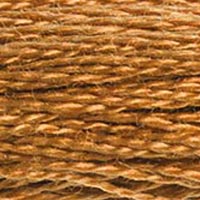
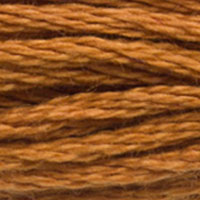
DMC 167 — Very Dark Yellow Beige
Browns family · Hex #A77C49
Quick Conversion Table
| Brand | Equivalent | Match |
|---|---|---|
| Anchor | 375 | close |
| Madeira | 2104 | close |
| Cosmo ⚠ | 737 | close |
| Sullivans | 45482 | close |
| J&P Coats | 5374 | close |
Cinnamon Stick Brown: The Spice Rack Essential
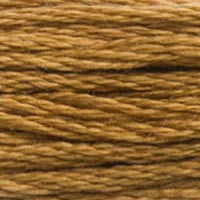
Pick up a cinnamon stick — a whole quill, not the ground powder — and really look at it. That warm, woody, slightly reddish brown with an undertone that's somehow both earthy and aromatic? That's DMC 167. This thread sits at the intersection of warm brown and muted gold, a color that immediately evokes spice markets, old apothecary drawers, and the warm-toned woods of antique furniture. It's darker and more serious than the typical yellow beiges in its family, with enough depth to anchor a warm palette without disappearing into the dark browns.
The "yellow beige" in the name can be misleading if you're shopping by name alone. This isn't a pale, sandy color — it's a rich, confident medium-dark brown with a distinctly warm, golden-yellow base. Think of it less as a beige that's been darkened and more as a brown that retained its warmth as it deepened. That distinction matters when you're building palettes, because 167 plays differently than a neutral or cool brown at the same value. It warms everything it touches.
On the color card, 167 reads as the deepest member of the yellow beige family, darker than its siblings DMC 3045 (Dark Yellow Beige), DMC 3046 (Medium Yellow Beige), and DMC 3047 (Light Yellow Beige). Together, these four threads create a gradient that moves from deep, spice-toned brown to pale, creamy beige — a progression that handles everything from shadowed leather to sunlit parchment. This kind of ready-made family is gold for pattern designers, and you'll find 167 anchoring the dark end of this range in countless sampler and nature designs.
Leather, Saddles, and Equestrian Stitching
If you've ever wondered what color thread best represents well-oiled leather — not new, not cracked and aged, but that perfect middle state of a saddle that's been cared for and ridden regularly — DMC 167 is your answer. The warm, slightly burnished quality of this thread captures the way good leather develops character. It's the color of a well-used bridle, a favorite leather journal, the worn handle of a vintage suitcase.
For equestrian-themed cross-stitch, 167 is indispensable. Saddles, reins, harnesses, and boots all live in this color territory. Use 167 for the body of leather tack, with DMC 3045 for areas catching light and DMC 3031 (Very Dark Mocha Brown) for creases and shadow details. The warm undertone is critical here — a cool or neutral brown for leather looks like plastic or rubber, while 167's warmth reads as organic, natural material.
Beyond equestrian subjects, 167 works for any design featuring leather goods: cowboy boots in a Western sampler, a leather-bound book on a library shelf, the straps on a vintage camera. In historical samplers and reproduction work, it captures the color of aged leather documents and book bindings with an authenticity that cooler browns miss entirely.
Warm Architecture and Timber
Architectural cross-stitch — samplers featuring houses, barns, churches, and streetscapes — relies heavily on threads like 167. This is the color of exposed timber framing in Tudor-style buildings, of hand-hewn beams in old barns, of cedar shingle siding that's weathered to a rich, warm patina. It reads as "real wood" in a way that's both specific and versatile, dark enough to define structural elements without overpowering the design.
For a sampler house with visible timber framing, try 167 for the main beam color, DMC 3862 (Dark Mocha Beige) for secondary wood elements, and DMC 3864 (Light Mocha Beige) for lighter woodwork like window frames and trim. The warm undertone running through all three keeps the wood elements feeling cohesive even as the values change. Add DMC 610 (Dark Drab Brown) for the oldest, most weathered timbers — the ones that have gone gray with age while their newer companions still show warm brown.
On fabric choice: 167 is one of those mid-value browns that can look quite different depending on the ground. On white Aida, it pops with warm intensity. On cream or antique white, it softens and integrates. On natural linen, it practically disappears into the fabric at certain angles, which can be either a problem or a feature depending on your design. If you're stitching 167 on linen and want it to read clearly, consider going up in strand count or choosing a linen with a lighter shade than the typical ecru.
Keeping the Warmth in Your Substitute
The biggest risk with substituting DMC 167 is ending up with a brown that has the right darkness but the wrong temperature. Cool or neutral browns at this value — and there are plenty of them in every brand's lineup — will flatten the warm, spice-toned quality that makes 167 distinctive. Whatever you reach for, hold it against a warm white surface and ask: does this glow, even slightly? If it just sits there looking brown, it's probably too neutral.
Anchor 375 is a close match that captures the warm undertone reasonably well, though some stitchers find it a touch more muted than the DMC original. For designs where 167 is one warm brown among several, this difference is unlikely to register in the finished piece. For designs where 167 carries the entire leather or wood palette, test carefully.
Madeira 2104 covers the same warm territory and is a solid substitute. Madeira's slightly different thread twist can produce marginally different light reflection, which at this particular warmth level can make the thread appear a shade lighter or darker depending on your stitching direction and lighting. Railroad your stitches consistently and the effect evens out.
Within the DMC range, the closest alternative is DMC 3828 (Hazelnut Brown), which shares 167's warm, nutty character but sits at a slightly different point on the value scale — you may find it reads as a half-step lighter. If your design can tolerate a subtle lightening in that area, 3828 is an excellent pinch-hitter. Going darker, DMC 869 (Very Dark Hazelnut Brown) continues the same warm family with more depth. Avoid substituting DMC 610 (Dark Drab Brown), which occupies a similar darkness but swings olive-cool rather than spice-warm — a fundamentally different character despite the similar value.
Reference quality
How We Validate This Color Record
Use this page as a reference card for DMC 167: the structured data, quick conversions, and long-form copy are all tied back to the same stored color record.
- Methodology
- This page renders DMC 167, its hex value, and every brand equivalent from the site's source-of-truth color record, then checks long-form body copy against those same stored fields.
- Verification status
- Source-field checked. The page content is audited against the stored DMC number, brand equivalents, and match-quality labels before publishing.
- Last reviewed
- 2026-04-20
- Approximation warning
- Screen hex values, thread photos, and cross-brand conversions are reference aids. Dye lots, thread sheen, and fabric color can still shift the result in hand.
Decision guide
When to use the DMC 167 reference page
This page should help you decide faster between palette planning, brand substitution, and shade comparison without turning the color record into a thin lookup page.
Best for
- + Palette planning when you want the stored DMC 167 Very Dark Yellow Beige record, hex value #A77C49, and linked brand equivalents in one place.
- + Checking the quickest cross-brand shortlist before you buy floss, compare stash substitutes, or route into a more specific conversion page.
- + Finding nearby shades in the browns family before you commit to accents, shading, or background blends.
Watch for
- ! Screen previews are only reference aids. Very Dark Yellow Beige can shift on real fabric because thread sheen, stitch coverage, and room lighting change how the color reads.
- ! A stored equivalent is still a shortlist, not a guarantee that two brands will disappear into each other in the same stitched motif.
- ! Older charts, discontinued kit floss, and dye-lot variation can all introduce small but visible differences that the page cannot detect for you.
Before you commit
- Confirm the role of DMC 167 Very Dark Yellow Beige: decide whether you need an exact hero shade, a forgiving background, or a rough stash substitute.
- Compare on project fabric: view the skein or stitched sample on the same fabric count and color you will actually use.
- Use the linked conversion pages next: open the brand-specific pages when you need match-quality caveats before substituting away from the DMC reference.
DMC 167 FAQ
These questions appear on the page so the FAQ schema stays aligned with what visitors can actually read.
What is the Anchor equivalent of DMC 167?+
The closest Anchor equivalent to DMC 167 (Very Dark Yellow Beige) is Anchor 375. This is a close match.
What color is DMC 167?+
DMC 167 is called "Very Dark Yellow Beige" and has a hex color value of #A77C49. It belongs to the browns color family.
What is the Madeira equivalent of DMC 167?+
The closest Madeira equivalent to DMC 167 (Very Dark Yellow Beige) is Madeira 2104. This is a close match.
How DMC 167 Looks on Fabric
The same thread appears different depending on your fabric. Always test on your project fabric.
White Aida
Cream / Ecru
Black Aida
Pairs Well With
DMC colors commonly used alongside 167 Very Dark Yellow Beige.
Suggested Palette

Shading Companions
Detailed Conversions
Where to Buy DMC 167
This section contains affiliate links. We may earn a small commission at no cost to you.
Related Guides
Free Printable Thread Conversion Chart
Pick a brand and download a printable chart mapping all 552 DMC colors to that brand's closest equivalents. Free — no signup needed.
Opens in a new tab. Use your browser's Print → Save as PDF.