
Quick Conversion Table
| Brand | Equivalent | Match |
|---|---|---|
| Anchor | 108 | exact |
| Madeira | 0802 | close |
| Cosmo ⚠ | 262 | close |
| Sullivans | 45042 | close |
| J&P Coats | 4303 | close |
| Dimensions | 6138 | close |
| Bucilla | 6139 | close |
| Candamar | 6138 | close |
There's a recurring conversation in cross-stitch communities about which purple is the most reliable workhorse purple — and DMC 210 Medium Lavender comes up constantly. Not because it's the flashiest shade in the purple family, but because it sits at exactly the right midpoint: warm enough to read as romantic and botanical, cool enough to pair with blues and grays without clashing. It's the purple that gets used when a pattern says "medium purple" and the designer actually means it.
Color Theory: Purple's Middle Ground
Purple is notoriously hard to manage in cross-stitch because it bridges warm red and cool blue. Lean too red and you get a magenta-adjacent purple that fights with true blues; lean too blue and it becomes almost violet, clashing with warm pinks and yellows. DMC 210 threads this needle well. Its undertones are balanced — slightly warm, with just enough red to read as unambiguously purple rather than blue-purple — which makes it cross-pollinate happily with both warm and cool palettes.
This versatility shows up in pattern use: DMC 210 appears in everything from delicate floral borders to fantasy landscapes to nursery samplers. It's one of those colors where the chart designer chose it not for drama but for reliability — it will look right in context almost regardless of what surrounds it.
The Lavender Family Hierarchy
DMC produces a clear lavender progression that's worth understanding as a system: DMC 211 (Light Lavender) sits above 210 as a softer, more faded version; DMC 209 (Dark Lavender) sits below as the richer, deeper option; DMC 208 (Very Dark Lavender) anchors the darkest end of this family. For shading work — flowers, shadows on purple fabric, gradients in fantasy or botanical designs — you can use this four-step family as a ready-made value scale.
DMC 210 functions as the core reference point in that progression. When shading a lavender flower, for example, you might use DMC 211 in the lightest petal areas, DMC 210 in the mid-tones, and DMC 209 for shadowed petals and the base of the flower where it joins the stem. Backstitching with DMC 208 or even DMC 553 (Violet) adds crisp definition without going to black.
Fabric Behavior and Practical Notes
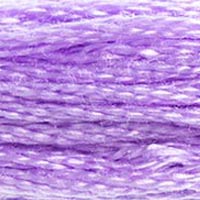
On white Aida, DMC 210 reads as a clean, medium-value lavender with a slight luminosity — it's one of those colors that seems to glow a little, catching the eye pleasantly. On natural linen or antique evenweave, the warm undertone in the fabric deepens the purple slightly and makes it feel more vintage and botanical. This is actually a happy accident for Victorian-style floral samplers, where that extra warmth adds authenticity.
The thread's sheen is typical DMC — slightly silky, railroading recommended for consistent coverage, especially when you're working with two strands over 14-count Aida. The stitches have a tendency to separate slightly if you let them twist up during a long stitching session, so stripping your strands and recombining them before threading pays off in a cleaner final result.
Anchor 108 is an exact match for DMC 210 — one of those relatively rare cases where the conversion is genuinely trustworthy rather than approximate. If you're switching between brands mid-project, this is a safe swap. Madeira 0802 and Cosmo 262 are close but not exact; both read as medium lavender but with slightly different saturation levels. Side-by-side comparison is worthwhile before committing to either in a piece where color consistency matters.
Sullivans 45042 sits in close territory. Sullivans threads tend to be slightly thicker than DMC on average, which can matter on high-count fabrics where thread coverage is carefully calibrated.
If you're mixing brand threads across the lavender family (say, using DMC 209 for shading but needing a substitute for the mid-tone), match the 210 as closely as possible in person rather than trusting published conversions. The difference between "exact" and "close" can be subtle under studio lighting but visible in strong daylight. For complementary pairings, DMC 3743 (Very Light Antique Violet) and DMC 341 (Light Blue Violet) both work alongside DMC 210 without creating jarring value jumps.
Reference quality
How We Validate This Color Record
Use this page as a reference card for DMC 210: the structured data, quick conversions, and long-form copy are all tied back to the same stored color record.
- Methodology
- This page renders DMC 210, its hex value, and every brand equivalent from the site's source-of-truth color record, then checks long-form body copy against those same stored fields.
- Verification status
- Source-field checked. The page content is audited against the stored DMC number, brand equivalents, and match-quality labels before publishing.
- Last reviewed
- 2026-04-20
- Approximation warning
- Screen hex values, thread photos, and cross-brand conversions are reference aids. Dye lots, thread sheen, and fabric color can still shift the result in hand.
Decision guide
When to use the DMC 210 reference page
This page should help you decide faster between palette planning, brand substitution, and shade comparison without turning the color record into a thin lookup page.
Best for
- + Palette planning when you want the stored DMC 210 Medium Lavender record, hex value #D29FC3, and linked brand equivalents in one place.
- + Checking the quickest cross-brand shortlist before you buy floss, compare stash substitutes, or route into a more specific conversion page.
- + Finding nearby shades in the purples family before you commit to accents, shading, or background blends.
Watch for
- ! Screen previews are only reference aids. Medium Lavender can shift on real fabric because thread sheen, stitch coverage, and room lighting change how the color reads.
- ! A stored equivalent is still a shortlist, not a guarantee that two brands will disappear into each other in the same stitched motif.
- ! Older charts, discontinued kit floss, and dye-lot variation can all introduce small but visible differences that the page cannot detect for you.
Before you commit
- Confirm the role of DMC 210 Medium Lavender: decide whether you need an exact hero shade, a forgiving background, or a rough stash substitute.
- Compare on project fabric: view the skein or stitched sample on the same fabric count and color you will actually use.
- Use the linked conversion pages next: open the brand-specific pages when you need match-quality caveats before substituting away from the DMC reference.
DMC 210 FAQ
These questions appear on the page so the FAQ schema stays aligned with what visitors can actually read.
What is the Anchor equivalent of DMC 210?+
The closest Anchor equivalent to DMC 210 (Medium Lavender) is Anchor 108. This is an exact match.
What color is DMC 210?+
DMC 210 is called "Medium Lavender" and has a hex color value of #D29FC3. It belongs to the purples color family.
What is the Madeira equivalent of DMC 210?+
The closest Madeira equivalent to DMC 210 (Medium Lavender) is Madeira 0802. This is a close match.
How DMC 210 Looks on Fabric
The same thread appears different depending on your fabric. Always test on your project fabric.
White Aida
Cream / Ecru
Black Aida
Pairs Well With
DMC colors commonly used alongside 210 Medium Lavender.
Suggested Palette
Shading Companions
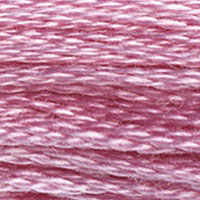
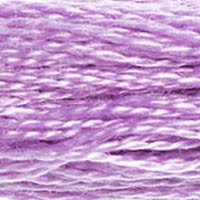
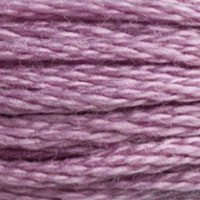
Detailed Conversions
Where to Buy DMC 210
This section contains affiliate links. We may earn a small commission at no cost to you.
Related Guides
Free Printable Thread Conversion Chart
Pick a brand and download a printable chart mapping all 552 DMC colors to that brand's closest equivalents. Free — no signup needed.
Opens in a new tab. Use your browser's Print → Save as PDF.