
Quick Conversion Table
| Brand | Equivalent | Match |
|---|---|---|
| Anchor | 862 | exact |
| Madeira | 2603 | close |
| Cosmo ⚠ | 635 | close |
| Sullivans | 45117 | close |
| J&P Coats | 6269 | close |
Forest Floor After Rain
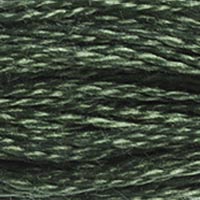
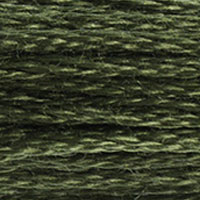
Walk through a deciduous woodland after a long rain and look down. Not at the bright ferns catching filtered sunlight — look at the older fronds, the ones close to the ground, half-curled and darkened by moisture and the beginning of decomposition. That concentrated, earthy, olive-leaning green is DMC 520. It's the darkest value in the 520/522/523/524 fern green family, and it grounds the entire group with a richness that feels genuinely organic rather than synthetic.
DMC names its colors with more poetry than precision sometimes, but "Dark Fern Green" is an unusually accurate label. This thread captures the specific quality of fern pigment — heavy in chlorophyll, with a yellow undertone that prevents it from reading as blue-green, and darkened just enough to suggest shade and density. Hold it next to DMC 319 (Very Dark Pistachio Green), which is a similar value but cooler and more blue, and you'll see why the name matters: 520 is warm-dark, while 319 is cool-dark. That difference controls whether your foliage feels temperate and deciduous or tropical and evergreen.
Historical Tapestry and the Hunt for Authentic Green
Reproduction tapestry work has a long and particular relationship with greens like 520. Medieval and Renaissance tapestries — the Unicorn Tapestries, the Lady and the Unicorn series, the Devonshire Hunting Tapestries — used greens that have aged into exactly this olive-warm range. The original dyes were typically weld (yellow) overdyed with woad (blue), and centuries of light exposure have faded the blue component faster than the yellow, leaving behind a dark, warm, slightly olive green that 520 approximates beautifully.
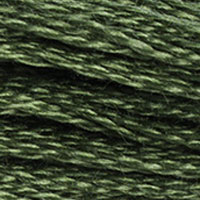
If you're stitching a historical reproduction or a design inspired by medieval millefleurs backgrounds, DMC 520 is essential. It works as the deep shadow behind flowers, as the darkest value in the ground foliage, and as the outline stitch that separates one plant form from another. In this context, pair it with DMC 522 (Fern Green) for mid-tone leaves and DMC 3013 (Light Khaki Green) for sun-touched highlights. Add DMC 834 (Very Light Golden Olive) for the golden tones in aged-thread reproductions, and DMC 3371 (Black Brown) for the deepest outlines where plants overlap.
Blending and Shading in the Yellow-Green Spectrum
Working with the yellow-green end of the spectrum requires different blending strategies than the blue-greens. Yellow-green shading tends to shift toward brown as it darkens (think autumn) and toward chartreuse as it lightens (think spring), and managing that natural drift is part of the craft. DMC 520 sits at the brown-leaning dark end, which means blending it with a lighter value that's too yellow — like DMC 907 (Light Parrot Green) — creates a jarring jump that reads as two different color families rather than a smooth gradient.
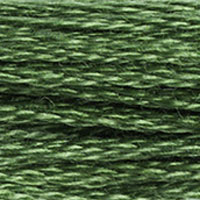
Instead, work through the fern greens in order: 520 to 522 to 523 to 524. Each step maintains the fern character while gently shifting the value. If you need additional intermediate steps, blended needle techniques work well here — one strand of 520 with one strand of 522 gives you a convincing half-step that bridges the gap in areas where the four-value gradient isn't smooth enough for the scale of your design. This is especially relevant on 18-count or higher, where each stitch is smaller and value jumps become more noticeable.
On 14-count Aida, two strands of 520 provide dense coverage with good color saturation. On evenweave over two, consider railroading to keep the stitches flat — the yellow undertone can shift if the strands twist and reflect light unevenly, creating patches that look slightly more olive than the surrounding stitches.
Anchor 862 matches both the value and that critical warm undertone, making it the safest substitute for mid-project emergencies. The coverage is comparable strand for strand, and the color holds consistently across dye lots — always a relief with the more complex, mixed-pigment shades where lot-to-lot variation can be a real concern.
Madeira 2603 delivers equally well on hue matching. Where Madeira sometimes surprises stitchers is in the slight difference in twist tension — you may find you need to adjust your railroading habit slightly, as the strands can behave a touch differently when laying flat. This is a minor consideration but worth noting if you're doing half-stitch or tent-stitch work where individual strand behavior is more visible.
Cosmo 635 approaches the right value but can lean slightly cooler, diluting some of that distinctive warm olive character. In a landscape design with multiple green values, this shift is easily absorbed by the surrounding palette. In a project where the fern green family is the dominant color story — a botanical illustration, a fern-themed sampler — you'll want to test Cosmo 635 against your other fern greens before committing. The family coherence of 520/522/523/524 is one of its strengths, and breaking that coherence at the dark end can unbalance the whole gradient.
Avoid substituting DMC 936 (Very Dark Avocado Green) or DMC 935 (Dark Avocado Green), which live in a similar value range but belong to a different color family. The avocado greens have a yellower, less blue character that reads differently even when the overall darkness is comparable.
Reference quality
How We Validate This Color Record
Use this page as a reference card for DMC 520: the structured data, quick conversions, and long-form copy are all tied back to the same stored color record.
- Methodology
- This page renders DMC 520, its hex value, and every brand equivalent from the site's source-of-truth color record, then checks long-form body copy against those same stored fields.
- Verification status
- Source-field checked. The page content is audited against the stored DMC number, brand equivalents, and match-quality labels before publishing.
- Last reviewed
- 2026-04-20
- Approximation warning
- Screen hex values, thread photos, and cross-brand conversions are reference aids. Dye lots, thread sheen, and fabric color can still shift the result in hand.
Decision guide
When to use the DMC 520 reference page
This page should help you decide faster between palette planning, brand substitution, and shade comparison without turning the color record into a thin lookup page.
Best for
- + Palette planning when you want the stored DMC 520 Dark Fern Green record, hex value #666D4F, and linked brand equivalents in one place.
- + Checking the quickest cross-brand shortlist before you buy floss, compare stash substitutes, or route into a more specific conversion page.
- + Finding nearby shades in the greens family before you commit to accents, shading, or background blends.
Watch for
- ! Screen previews are only reference aids. Dark Fern Green can shift on real fabric because thread sheen, stitch coverage, and room lighting change how the color reads.
- ! A stored equivalent is still a shortlist, not a guarantee that two brands will disappear into each other in the same stitched motif.
- ! Older charts, discontinued kit floss, and dye-lot variation can all introduce small but visible differences that the page cannot detect for you.
Before you commit
- Confirm the role of DMC 520 Dark Fern Green: decide whether you need an exact hero shade, a forgiving background, or a rough stash substitute.
- Compare on project fabric: view the skein or stitched sample on the same fabric count and color you will actually use.
- Use the linked conversion pages next: open the brand-specific pages when you need match-quality caveats before substituting away from the DMC reference.
DMC 520 FAQ
These questions appear on the page so the FAQ schema stays aligned with what visitors can actually read.
What is the Anchor equivalent of DMC 520?+
The closest Anchor equivalent to DMC 520 (Dark Fern Green) is Anchor 862. This is an exact match.
What color is DMC 520?+
DMC 520 is called "Dark Fern Green" and has a hex color value of #666D4F. It belongs to the greens color family.
What is the Madeira equivalent of DMC 520?+
The closest Madeira equivalent to DMC 520 (Dark Fern Green) is Madeira 2603. This is a close match.
How DMC 520 Looks on Fabric
The same thread appears different depending on your fabric. Always test on your project fabric.
White Aida
Cream / Ecru
Black Aida
Pairs Well With
DMC colors commonly used alongside 520 Dark Fern Green.
Suggested Palette
Shading Companions
Detailed Conversions
Where to Buy DMC 520
This section contains affiliate links. We may earn a small commission at no cost to you.
Related Guides
Free Printable Thread Conversion Chart
Pick a brand and download a printable chart mapping all 552 DMC colors to that brand's closest equivalents. Free — no signup needed.
Opens in a new tab. Use your browser's Print → Save as PDF.