
Quick Conversion Table
| Brand | Equivalent | Match |
|---|---|---|
| Anchor | 35 | exact |
| Madeira | 0412 | close |
| Cosmo ⚠ | 206 | close |
| Sullivans | 45244 | close |
| J&P Coats | 3012 | close |
| Dimensions | 6217 | close |
| Bucilla | 2612 | close |
The carnation flower earns its cross-stitch thread family in part through sheer history — carnations appear in European embroidery dating back to the Renaissance, carried symbolic weight in both religious and secular imagery, and were among the first garden flowers to be stylized into geometric embroidery motifs in the seventeenth and eighteenth centuries. The DMC carnation family (891-894) captures the range of this flower's coloring from its most intense, saturated depth to its softest pale version. 891, Dark Carnation, is the family's deepest and most vivid member.
Hot Pink With Depth
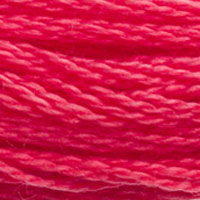
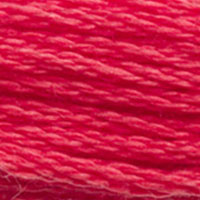
At hex #FF5773, 891 reads as what interior designers would call a "saturated warm pink" — there's enough red in it to feel warm, enough blue to register as true pink rather than coral, and a saturation high enough that it simply cannot be ignored in any composition it inhabits. Unlike the more muted garnet or rose families, the carnation family's pinks have a vivid, garden-flower quality that demands visibility. 891's dark value version of this quality gives it the depth to function as both a shadow color in a gradient and as a primary design color in its own right.
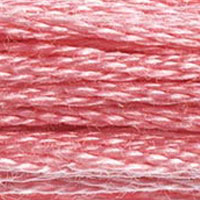
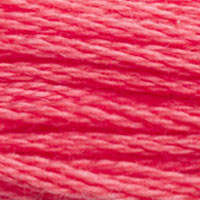
The specific relationship between 891 and its family members — 892 (Medium Carnation), 893 (Light Carnation), and 894 (Very Light Carnation) — makes gradient work in the carnation family among the more satisfying in the DMC line. The value steps are well-calibrated and the hue remains consistent across the range, so gradients from 891 to 894 look smooth and natural rather than patchy or inconsistent.
Floral and Garden Designs
Carnations, of course, but also peonies, roses in the pink-magenta range, dahlias, and any garden flower with a saturated warm-pink coloring. 891 handles the shadow petals and the deepest interior moments in large, full-bloom florals. For a peony rendered with genuine depth — the center petals crowded and shadowed by the outer layers — 891 in the innermost shadow area makes the surrounding lighter pink values (892, 893, and 894) read as genuinely lit and three-dimensional by contrast.
Modern, maximalist floral cross-stitch — the kind that appears in SAL projects and larger kit designs, with complex multi-petaled flowers and lush foliage — reaches for 891 as one of the essential saturated pinks in a warm floral palette. Paired with DMC 335 (Rose) and DMC 326 (Very Dark Rose) for the red-rose range, and 892 through 894 for the lighter carnation range, 891 anchors the vivid hot-pink zone of a full floral palette.
Valentine and Romantic Design Applications
Valentine's Day designs, romantic-themed ornaments, and any piece that celebrates love, romance, or femininity in a bold palette reach for 891. The color reads as assertively pink in a way that roses or muted dusty pinks don't — it's the choice when you want pink that makes a statement. Cross-stitch bookmarks, small ornaments, and greeting card-sized pieces that need to read immediately as romantic and vivid use 891 as their primary color or deep accent.
Stitchers who work on Japanese-inspired designs that include sakura (cherry blossom) in a bolder, more graphic interpretation rather than a naturalistic one often use 891 for the deepest petal areas. Traditional Japanese textile patterns interpreted in cross-stitch benefit from the carnation family's vivid quality over the softer rose or dusty rose alternatives.
Both Anchor 35 and Madeira 0412 earn exact match ratings, making 891 well-calibrated across the three major brands. For vivid saturated pinks, which can be some of the harder colors to match accurately because of how sensitive eyes are to shifts in hue at high saturation, these exact matches are especially valuable.
Cosmo 206 and Sullivans 45244 are close matches. At 891's high saturation level, Cosmo's thread finish can make their equivalent read as slightly more vivid or slightly different in warmth — the combination of saturation and silkier thread can amplify minor hue differences in a way that doesn't happen with muted or dark colors. Testing in your fabric and lighting is particularly worthwhile for high-saturation pinks.
Within DMC, 891 is the darkest member of the carnation family. If it's unavailable and you need a deep, vivid pink, DMC 892 (Medium Carnation) is the lighter next step in the same family and works in designs where 891 was the darkest accent — you lose depth but retain the carnation family character. For designs where 891 was specifically chosen for being the darkest available vivid pink rather than for family coherence, DMC 326 (Very Dark Rose) or DMC 335 (Rose) are alternative dark-pink options with different undertone characters.
One thing to note: the carnation family's vivid pinks are used in so many popular patterns that 891 is frequently in demand. If you stitch a lot of floral designs, keeping a spare skein in your stash saves the frustration of discovering you're out mid-project when local stores are unlikely to have it on the shelf.
Reference quality
How We Validate This Color Record
Use this page as a reference card for DMC 891: the structured data, quick conversions, and long-form copy are all tied back to the same stored color record.
- Methodology
- This page renders DMC 891, its hex value, and every brand equivalent from the site's source-of-truth color record, then checks long-form body copy against those same stored fields.
- Verification status
- Source-field checked. The page content is audited against the stored DMC number, brand equivalents, and match-quality labels before publishing.
- Last reviewed
- 2026-04-20
- Approximation warning
- Screen hex values, thread photos, and cross-brand conversions are reference aids. Dye lots, thread sheen, and fabric color can still shift the result in hand.
Decision guide
When to use the DMC 891 reference page
This page should help you decide faster between palette planning, brand substitution, and shade comparison without turning the color record into a thin lookup page.
Best for
- + Palette planning when you want the stored DMC 891 Dark Carnation record, hex value #FF5773, and linked brand equivalents in one place.
- + Checking the quickest cross-brand shortlist before you buy floss, compare stash substitutes, or route into a more specific conversion page.
- + Finding nearby shades in the pinks family before you commit to accents, shading, or background blends.
Watch for
- ! Screen previews are only reference aids. Dark Carnation can shift on real fabric because thread sheen, stitch coverage, and room lighting change how the color reads.
- ! A stored equivalent is still a shortlist, not a guarantee that two brands will disappear into each other in the same stitched motif.
- ! Older charts, discontinued kit floss, and dye-lot variation can all introduce small but visible differences that the page cannot detect for you.
Before you commit
- Confirm the role of DMC 891 Dark Carnation: decide whether you need an exact hero shade, a forgiving background, or a rough stash substitute.
- Compare on project fabric: view the skein or stitched sample on the same fabric count and color you will actually use.
- Use the linked conversion pages next: open the brand-specific pages when you need match-quality caveats before substituting away from the DMC reference.
DMC 891 FAQ
These questions appear on the page so the FAQ schema stays aligned with what visitors can actually read.
What is the Anchor equivalent of DMC 891?+
The closest Anchor equivalent to DMC 891 (Dark Carnation) is Anchor 35. This is an exact match.
What color is DMC 891?+
DMC 891 is called "Dark Carnation" and has a hex color value of #FF5773. It belongs to the pinks color family.
What is the Madeira equivalent of DMC 891?+
The closest Madeira equivalent to DMC 891 (Dark Carnation) is Madeira 0412. This is a close match.
The carnation family's four-thread gradient (891-894) makes it one of the best choices for standalone floral bookmarks and ornaments, where the limited color palette needs to do a lot of work. A single carnation or peony motif worked in all four family values — 891 for shadow petals, 892 for mid-depth, 893 for lit petals, and 894 for the palest highlight moments — creates a finished piece of surprising richness for its small size.
Hardanger and traditional Norwegian embroidery sometimes incorporate carnation-pink accents alongside the characteristic white broderie anglaise elements, using 891 as the deep accent in a palette that's otherwise cream and white. The vivid pink reads as deliberately celebratory in this context.
For stitchers building sampler collections, a carnation-family color card sampler — working small stitched swatches of 891, 892, 893, and 894 in a grid format with thread code labels — makes a practical and beautiful reference piece that lives near your stitching setup. The four values together demonstrate the gradient range clearly in a way that the skeins on a color card cannot.
How DMC 891 Looks on Fabric
The same thread appears different depending on your fabric. Always test on your project fabric.
White Aida
Cream / Ecru
Black Aida
Pairs Well With
DMC colors commonly used alongside 891 Dark Carnation.
Suggested Palette
Shading Companions
Detailed Conversions
Where to Buy DMC 891
This section contains affiliate links. We may earn a small commission at no cost to you.
Related Guides
Free Printable Thread Conversion Chart
Pick a brand and download a printable chart mapping all 552 DMC colors to that brand's closest equivalents. Free — no signup needed.
Opens in a new tab. Use your browser's Print → Save as PDF.