
Quick Conversion Table
| Brand | Equivalent | Match |
|---|---|---|
| Anchor | 333 | exact |
| Madeira | 0208 | close |
| Cosmo ⚠ | 758 | close |
| Sullivans | 45251 | close |
| J&P Coats | 2329 | close |
| Bucilla | 900 | close |
| Candamar | 6207 | close |
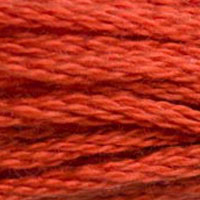
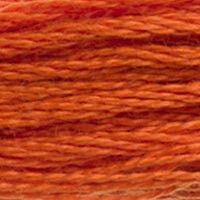
Autumn does something particular to the eye: it trains you to see orange not as a single note but as an entire octave. DMC 900 Dark Burnt Orange sits at the heart of that range — deep enough to carry shadows, warm enough to glow against dark backgrounds, and saturated enough to feel genuinely autumnal rather than just orange-adjacent. It reads as a color you could almost feel the heat of, the way late-afternoon October light does when it catches the edge of a turning maple leaf.
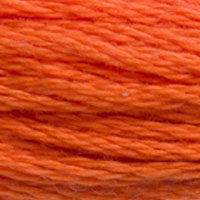
The 900–922 copper-to-orange range in DMC is built for stitchers who need to render earthy warmth across multiple values. DMC 900 anchors the deep end of that run, sitting several steps darker than its sibling DMC 921 (Copper) and substantially darker than the brighter DMC 922 (Light Copper). If you're building a gradient through autumn foliage, 900 often serves as the near-shadow value, with DMC 919 (Red Copper) or DMC 918 (Dark Red Copper) pulling things darker still when you need to go fully into the shaded underside of a leaf.
Where This Color Earns Its Keep
The most obvious home for DMC 900 is seasonal work: pumpkins, autumn wreaths, harvest tables, fall foliage. But stitchers who've spent time with it discover it's equally useful in contexts that have nothing to do with October. Terracotta pottery rendered in cross-stitch needs 900 for its deepest shaded sides. Koi fish patterns pull on this color for the rich underbelly shading. Southwestern and Native American-inspired patterns use 900 extensively for their characteristic warm earth tones alongside DMC 355 (Dark Terra Cotta) and DMC 356 (Medium Terra Cotta).
On Aida, DMC 900 reads clearly and cleanly — the saturation is high enough that it doesn't muddy on 14-count or 18-count. On natural linen, it picks up a slightly more muted quality that actually works beautifully for historical or rustic aesthetics. If you're stitching over-two on evenweave, this color fills coverage impressively; the depth of pigment means even partial coverage looks intentional.
Palette Building with 900
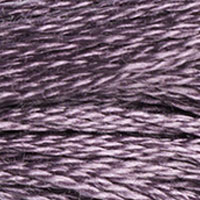
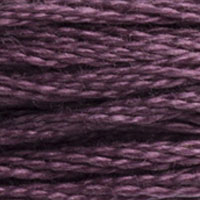
The complementary axis for DMC 900 runs toward teal and slate blues — DMC 924 (Very Dark Gray Green) and DMC 926 (Medium Gray Green) create a high-contrast pairing that feels less predictable than straight blue. For a warmer complementary relationship, the blue-greens around DMC 3808 and DMC 3809 work well. If you're designing your own pattern and want a classic high-contrast autumn palette, try pairing 900 with DMC 500 (Very Dark Blue Green) for shadows and DMC 307 (Lemon) for extreme highlight contrast — it's the color language of a Japanese maple in morning light.
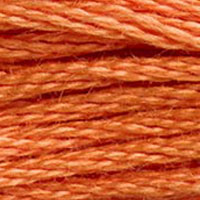
For monochromatic shading through orange, the family runs: DMC 900 (Dark Burnt Orange) → DMC 920 (Medium Copper) → DMC 921 (Copper) → DMC 922 (Light Copper). Adding DMC 3340 (Medium Apricot) at the lighter end gives you nearly six stops of value for smooth gradient work or thread painting.
Stitch Behavior and Technique Notes
DMC 900 is one of those colors that benefits from railroading on longer stitches. Because it's deeply saturated, any twist in the thread changes the way light hits it noticeably — a twisted stitch will look slightly different in tone from a well-laid one, and with this level of color intensity, that irregularity can pull the eye. Taking a moment to railroad when filling larger areas keeps the surface consistent.
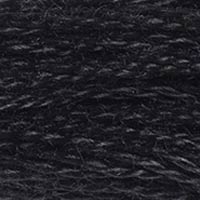
For backstitching, 900 is rarely the right choice on its own — it's generally too warm to function as a neutral outline. But used as an accent backstitch over lighter orange or yellow fills, it creates an organic, shadow-line quality that feels less mechanical than DMC 310 (Black) or DMC 3371 (Black Brown) on warm subjects. Some stitchers building realistic autumn leaves use 900 for vein detailing within the leaf body itself, reserving darker shades for the outer outline.
Blended needle work with 900 is worth exploring. One strand of 900 combined with one strand of DMC 720 (Dark Orange Spice) produces an intermediate value with slightly more red-orange warmth, useful for smoothing transitions in large shaded areas where the standard DMC steps feel too abrupt.
The Anchor 333 match for DMC 900 is rated exact, and in practice it holds up well — Anchor 333 lands in the same deep burnt orange territory without significant value shift. Anchor threads tend to have a slightly different sheen profile than DMC, so side-by-side in the same piece you might notice a subtle difference in how light reflects off the surface, but color-wise the match is reliable. If your project is entirely Anchor or switching wholesale, this conversion is one you can trust.
Madeira 0208 also carries an exact rating and is a genuinely good match. Madeira's color formulation in the orange-brown range has historically been consistent, and 0208 represents that well. Madeira threads have a reputation for excellent colorfastness, which matters for pieces you intend to frame or display long-term.
Cosmo 758 and Sullivans 45251 both carry close ratings rather than exact. The Cosmo version trends slightly more toward true orange and may read as marginally brighter. For most designs where 900 is used as a mid-tone filler, this is unlikely to matter. Where it could cause problems is in gradient sequences — if you're building a careful value progression and swap only the 900 position to Cosmo 758, you may find a slightly irregular step at that point in the range. Test the full gradient before committing.
If DMC 900 is genuinely unavailable, DMC 919 (Red Copper) can substitute in roles where the red-orange shift is acceptable. For contexts needing the pure orange quality without the depth, DMC 920 (Medium Copper) is the nearest neighbor in the lighter direction. Neither is a drop-in replacement, but both will read as tonally related in most contexts.
Reference quality
How We Validate This Color Record
Use this page as a reference card for DMC 900: the structured data, quick conversions, and long-form copy are all tied back to the same stored color record.
- Methodology
- This page renders DMC 900, its hex value, and every brand equivalent from the site's source-of-truth color record, then checks long-form body copy against those same stored fields.
- Verification status
- Source-field checked. The page content is audited against the stored DMC number, brand equivalents, and match-quality labels before publishing.
- Last reviewed
- 2026-04-20
- Approximation warning
- Screen hex values, thread photos, and cross-brand conversions are reference aids. Dye lots, thread sheen, and fabric color can still shift the result in hand.
Decision guide
When to use the DMC 900 reference page
This page should help you decide faster between palette planning, brand substitution, and shade comparison without turning the color record into a thin lookup page.
Best for
- + Palette planning when you want the stored DMC 900 Dark Burnt Orange record, hex value #D15807, and linked brand equivalents in one place.
- + Checking the quickest cross-brand shortlist before you buy floss, compare stash substitutes, or route into a more specific conversion page.
- + Finding nearby shades in the oranges family before you commit to accents, shading, or background blends.
Watch for
- ! Screen previews are only reference aids. Dark Burnt Orange can shift on real fabric because thread sheen, stitch coverage, and room lighting change how the color reads.
- ! A stored equivalent is still a shortlist, not a guarantee that two brands will disappear into each other in the same stitched motif.
- ! Older charts, discontinued kit floss, and dye-lot variation can all introduce small but visible differences that the page cannot detect for you.
Before you commit
- Confirm the role of DMC 900 Dark Burnt Orange: decide whether you need an exact hero shade, a forgiving background, or a rough stash substitute.
- Compare on project fabric: view the skein or stitched sample on the same fabric count and color you will actually use.
- Use the linked conversion pages next: open the brand-specific pages when you need match-quality caveats before substituting away from the DMC reference.
DMC 900 FAQ
These questions appear on the page so the FAQ schema stays aligned with what visitors can actually read.
What is the Anchor equivalent of DMC 900?+
The closest Anchor equivalent to DMC 900 (Dark Burnt Orange) is Anchor 333. This is an exact match.
What color is DMC 900?+
DMC 900 is called "Dark Burnt Orange" and has a hex color value of #D15807. It belongs to the oranges color family.
What is the Madeira equivalent of DMC 900?+
The closest Madeira equivalent to DMC 900 (Dark Burnt Orange) is Madeira 0208. This is a close match.
How DMC 900 Looks on Fabric
The same thread appears different depending on your fabric. Always test on your project fabric.
White Aida
Cream / Ecru
Black Aida
Pairs Well With
DMC colors commonly used alongside 900 Dark Burnt Orange.
Suggested Palette
Shading Companions
Detailed Conversions
Where to Buy DMC 900
This section contains affiliate links. We may earn a small commission at no cost to you.
Related Guides
Free Printable Thread Conversion Chart
Pick a brand and download a printable chart mapping all 552 DMC colors to that brand's closest equivalents. Free — no signup needed.
Opens in a new tab. Use your browser's Print → Save as PDF.