
Quick Conversion Table
| Brand | Equivalent | Match |
|---|---|---|
| Anchor | 310 | exact |
| Madeira | 2009 | close |
| Cosmo ⚠ | 309 | close |
| Sullivans | 45095 | close |
| J&P Coats | 5000 | close |
| Dimensions | 6095 | close |
| Bucilla | 434 | close |
| Candamar | 6095 | close |
The Forest Floor Workhorse
Every cross-stitch brown family needs a center of gravity — the shade that isn't dramatic, isn't subtle, isn't especially warm or cool, but just sits there doing the work. In the 433-435 sequence, DMC 434 is that center. It's the brown that most people picture when they hear the word "brown": medium depth, warm without being golden, balanced without being grey, neutral enough to play any role but distinctive enough to carry a design. If you had to stitch the word "brown" in a color that perfectly illustrated its own meaning, you'd reach for 434.
On the forest floor, this is everywhere. It's the decaying leaf litter that's broken down past its original color but hasn't yet become soil. It's the bracket fungus on the side of a fallen log — not the fresh, bright kind but the dried, mature kind that's hardened into a woody shelf. It's the color of a chanterelle's cap when it's still slightly damp, or the underside of a portobello mushroom just before the gills darken to black. Mushroom cross-stitch patterns — and there are more of them than you might expect, thanks to the cottagecore revival — lean heavily on this exact value of brown.
Brown as Shadow: Crossing Family Lines
Here's a technique that experienced stitchers know but beginners often don't consider: brown makes an excellent shadow color for things that aren't brown. Pure shadow — the kind you get by just using a darker version of the same hue — can look unnatural. Real shadows aren't just "dark blue" or "dark green"; they're complex, often brownish, because shadow areas in real life pick up reflected color from the ground, which is usually some shade of brown or grey.
DMC 434 is perfectly positioned for this kind of cross-family shadow work. As a shadow under green foliage, it creates a convincing transition from leaf to earth. One strand of 434 blended with one strand of DMC 3051 (Dark Green Grey) makes a shadow green that looks naturally grounded rather than artificially darkened. As a shadow in yellow flowers, 434 adds the depth that a darker yellow can't — yellow darkened just becomes muddy olive, but yellow shadowed with warm brown looks like a sunflower's center or the shaded side of a daffodil trumpet.
In landscape stitching specifically, 434 operates as the universal shadow anchor for foreground elements. The convention in landscape perspective is that foreground objects are warmer and more saturated while background objects are cooler and more muted. DMC 434, as a warm, saturated mid-brown, reads as unambiguously "close" in a landscape composition. Use it for path edges, fence posts, fallen branches, and garden beds in the foreground, while lighter, cooler browns like DMC 841 (Light Beige Brown) or DMC 842 (Very Light Beige Brown) handle the distant hills and far-off tree lines.
The 433-435 Gradient: Brown's Backbone
The sequence of DMC 433 (Medium Brown), 434 (Light Brown), and 435 (Very Light Brown) is one of the most commonly used three-step gradients in the entire DMC system. These three threads appear together on more pattern thread lists than almost any other brown combination. They handle tree trunks, wooden fences, garden paths, roof beams, wicker furniture, picture frames within designs, and dozens of other applications where you need a simple light-to-dark brown progression.
What makes this trio work so well is the even spacing between values. The steps from 433 to 434 to 435 are perceptually equal — each one is noticeably lighter than the last without any awkward jumps or compressions. Extend the range with DMC 801 (Dark Coffee Brown) at the shadow end and DMC 436 (Tan) and DMC 437 (Light Tan) at the light end, and you have a six-step neutral brown gradient that can handle virtually any brown surface with smooth, natural-looking shading.
For stitching tree trunk rings — a cross-section view showing growth rings — start with DMC 801 at the darkest heartwood center, step through 433 and 434 for the intermediate rings, then use 435 and 436 for the younger sapwood near the bark. Each ring is a single row of cross-stitches in the appropriate value, and the natural, even progression of the 433-437 family creates a convincing record of annual growth. Add DMC 3371 (Black Brown) for the bark itself — a dark, hard outline around the softer interior wood — and the cross-section tells a story.
Replacing the Quintessential Brown
You'd think the most generic brown would be the easiest to substitute for — and you'd mostly be right. DMC 434 doesn't have the extreme undertones or unusual characteristics that make some colors tricky. But "generic" doesn't mean "any brown will do." You still need to match the specific value and the neutral-warm balance that makes 434 the versatile center-ground thread it is.
Anchor 310 is rated exact and is a dependable swap. Madeira 2009 is equally exact. Both maintain the neutral warmth that defines 434 — warm enough to be clearly a brown and not a grey, but not so warm that it tilts into golden or russet territory. For most projects, either substitute is a drop-in replacement.
Cosmo 309 is close and generally reliable, though as with many Cosmo-to-DMC comparisons, there can be subtle differences in thread weight and twist that affect coverage slightly on higher-count fabrics. If you're stitching on 18-count or higher, stitch a test swatch to verify that coverage matches what you'd get with the DMC original. Sullivans 45095 is similarly in range — a solid option when DMC isn't available.
Within the DMC system, the most confusing near-neighbor is DMC 435 (Very Light Brown), which is just one step lighter. In the skein, 434 and 435 look more different than they do once stitched, because the cross-stitch structure compresses visual contrast. If your pattern uses both 434 and 435 and you can only find one, the other's substitute needs to maintain that step of separation. Don't use 436 (Tan) as a substitute for 434 — it's two steps lighter, and the gap will be visible in any shading sequence. Similarly, don't reach for DMC 975 (Dark Golden Brown) thinking it's close; 975 has a strong golden undertone that 434 completely lacks.
Reference quality
How We Validate This Color Record
Use this page as a reference card for DMC 434: the structured data, quick conversions, and long-form copy are all tied back to the same stored color record.
- Methodology
- This page renders DMC 434, its hex value, and every brand equivalent from the site's source-of-truth color record, then checks long-form body copy against those same stored fields.
- Verification status
- Source-field checked. The page content is audited against the stored DMC number, brand equivalents, and match-quality labels before publishing.
- Last reviewed
- 2026-04-20
- Approximation warning
- Screen hex values, thread photos, and cross-brand conversions are reference aids. Dye lots, thread sheen, and fabric color can still shift the result in hand.
Decision guide
When to use the DMC 434 reference page
This page should help you decide faster between palette planning, brand substitution, and shade comparison without turning the color record into a thin lookup page.
Best for
- + Palette planning when you want the stored DMC 434 Light Brown record, hex value #985E33, and linked brand equivalents in one place.
- + Checking the quickest cross-brand shortlist before you buy floss, compare stash substitutes, or route into a more specific conversion page.
- + Finding nearby shades in the browns family before you commit to accents, shading, or background blends.
Watch for
- ! Screen previews are only reference aids. Light Brown can shift on real fabric because thread sheen, stitch coverage, and room lighting change how the color reads.
- ! A stored equivalent is still a shortlist, not a guarantee that two brands will disappear into each other in the same stitched motif.
- ! Older charts, discontinued kit floss, and dye-lot variation can all introduce small but visible differences that the page cannot detect for you.
Before you commit
- Confirm the role of DMC 434 Light Brown: decide whether you need an exact hero shade, a forgiving background, or a rough stash substitute.
- Compare on project fabric: view the skein or stitched sample on the same fabric count and color you will actually use.
- Use the linked conversion pages next: open the brand-specific pages when you need match-quality caveats before substituting away from the DMC reference.
DMC 434 FAQ
These questions appear on the page so the FAQ schema stays aligned with what visitors can actually read.
What is the Anchor equivalent of DMC 434?+
The closest Anchor equivalent to DMC 434 (Light Brown) is Anchor 310. This is an exact match.
What color is DMC 434?+
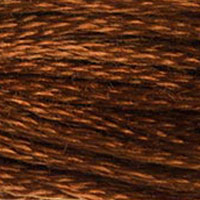
DMC 434 is called "Light Brown" and has a hex color value of #985E33. It belongs to the browns color family.
What is the Madeira equivalent of DMC 434?+
The closest Madeira equivalent to DMC 434 (Light Brown) is Madeira 2009. This is a close match.
How DMC 434 Looks on Fabric
The same thread appears different depending on your fabric. Always test on your project fabric.
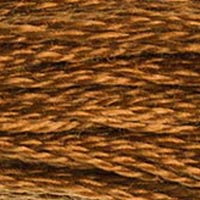
White Aida
Cream / Ecru
Black Aida
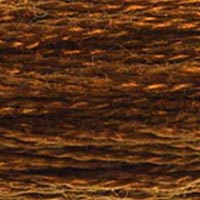
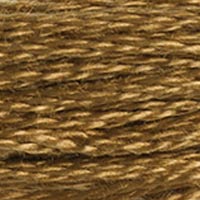
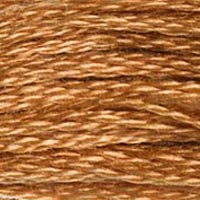
Pairs Well With
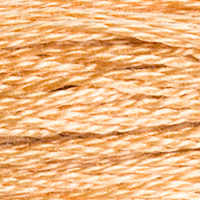
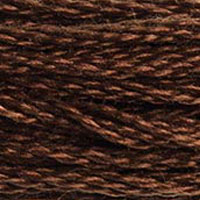
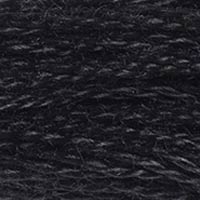
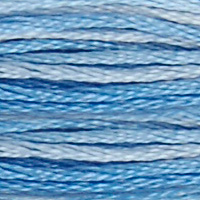
DMC colors commonly used alongside 434 Light Brown.
Detailed Conversions
Where to Buy DMC 434
This section contains affiliate links. We may earn a small commission at no cost to you.
Related Guides
Free Printable Thread Conversion Chart
Pick a brand and download a printable chart mapping all 552 DMC colors to that brand's closest equivalents. Free — no signup needed.
Opens in a new tab. Use your browser's Print → Save as PDF.