
Quick Conversion Table
| Brand | Equivalent | Match |
|---|---|---|
| Anchor | 357 | exact |
| Madeira | 2303 | exact |
| Cosmo ⚠ | 130 | close |
| Sullivans | 45304 | close |
| J&P Coats | 5356 | close |
| Dimensions | 6975 | close |
| Bucilla | 927 | close |
| Candamar | 6094 | close |
Autumn Captured in a Six-Strand Skein
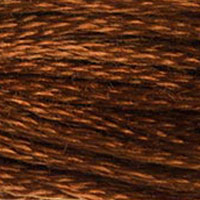
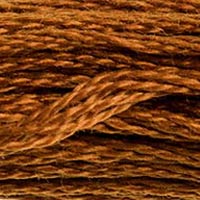
Pull a length of DMC 975 from the skein, hold it up to October afternoon light, and you're looking at the season itself. This is the color of acorns still wearing their caps. Dark wildflower honey held up to a window. Amber resin beading on pine bark. Polished walnut heartwood. The last leaf clinging to an oak branch, backlit by a low autumn sun. If fall had a signature thread, 975 would be the one.
What makes 975 special among the browns isn't just its warmth — plenty of DMC browns are warm — it's where that warmth sits on the spectrum. This thread occupies the bridge between brown and gold, a territory that most color systems struggle to name. It's too dark and saturated to be a tan, too golden to be a chocolate, too brown to be an amber. It lives in that gap, and that's exactly why stitchers reach for it when they need a color that glows with inner warmth without tipping into the oranges.
On the needle, 975 has a rich, almost luminous quality that photographs well and looks gorgeous under both natural and artificial light — a trait not every brown can claim. Some darker browns go flat and muddy under tungsten or LED light, but 975's golden undertone keeps it alive. Two strands on 14-count Aida give you full, warm coverage with no fabric showing through. On 18-count, railroad your stitches to keep the strands lying parallel; the golden sheen is most apparent when light reflects evenly off flat, well-laid threads.
The Warm Bridge Between Brown and Gold
Understanding 975's role in the DMC color system helps you use it strategically. It sits in a golden brown corridor that includes DMC 976 (Medium Golden Brown) and DMC 977 (Light Golden Brown), giving you a ready-made three-step gradient with beautiful warmth throughout. Unlike the neutral brown family (433, 434, 435, 436, 437) which trends cooler and more "wood-toned," the 975-976-977 family stays resolutely warm and amber-toned from shadow to highlight.
This makes the golden brown family the natural choice for anything that needs to glow: autumn foliage, brass and copper metalwork, caramel and butterscotch, lion manes, golden retrievers, wheat fields at sunset, honey in a jar. Pair 975 with DMC 301 (Medium Mahogany) for a richer shadow beneath the golden browns, or drop down to DMC 898 (Very Dark Coffee Brown) when you need the deepest anchor point in an amber-toned palette.
For autumn foliage specifically, try building a leaf palette with 975 as your dark gold, 976 as your medium, and then branching into the reds with DMC 920 (Medium Copper) and DMC 921 (Copper) for those leaves that are caught between gold and red. Add DMC 3826 (Golden Brown) as a warmer alternative mid-tone, and you've got a six-thread palette that can handle an entire autumn canopy with convincing color variation.
Fabric Choice and the Golden Glow Effect
Fabric choice matters more with 975 than with many threads, because the golden undertone interacts visibly with whatever it sits on. On bright white Aida, 975 looks its most saturated and amber — maximum contrast, maximum warmth. On cream or antique white fabric, the warmth softens slightly and the thread integrates more naturally, which is usually what you want for a fall landscape or a rustic design. On natural linen, 975 practically sings — the flax color of the fabric and the golden brown of the thread are close relatives, and the combination has an organic, harvest-season warmth that's hard to achieve on stark white.
For over-one stitching on higher counts (28-count and above), 975 is forgiving. The rich pigmentation means even a single strand carries good color density, and the warm tone doesn't wash out the way lighter golds can when stitched over one. If you're working a miniature autumn piece or a detailed ornament on 28-count evenweave over one, 975 holds its own without looking faded or thin.
One practical note on tent stitch for needlepoint: 975 in DMC cotton doesn't have the coverage you'd want for canvas work. If you're drawn to this color for a needlepoint project, look at DMC's tapestry wool range or Persian wool in a matching shade. The cotton floss is engineered for counted cross-stitch and surface embroidery, and it will leave canvas threads visible no matter how carefully you stitch.
Matching DMC 975's Golden Warmth
The golden undertone is everything here. Match the darkness without matching the warmth and you'll end up with a flat, ordinary brown that completely misses what makes 975 special. Your substitute needs to glow.
Anchor 357 and Madeira 2303 are both rated exact, and both are reliable choices. Anchor 357 captures the amber quality nicely and tends to be consistent across dye lots — I've used it interchangeably with DMC 975 in a couple of projects without any visible difference in the FO. Madeira 2303 is equally well matched in hue, and Madeira's rayon-like sheen can actually enhance the golden quality slightly, giving stitches a subtle luminosity that works beautifully in autumn-themed pieces.
Cosmo 130 is close and leans appropriately warm, though some stitchers find Cosmo's version a hair less saturated than the DMC original. For blending into a multi-shade gradient (975-976-977), verify that your Cosmo substitute plays well with whichever brand you're using for the lighter values. A cross-brand gradient can work beautifully, but you need to check the transitions in person — photographing your test stitches can deceive you because cameras handle warm browns inconsistently.
Sullivans 45304 gets you into the right zone. As with any substitute at this warmth level, check your candidate in natural daylight rather than under artificial light. Incandescent bulbs add warmth to everything, which can mask a substitute that's actually too cool; LED daylight bulbs can strip warmth, making a perfectly good match look too flat. Step near a window, hold the skeins side by side against your fabric, and trust your eyes.
If you're looking within the DMC range for a near-substitute because 975 is out of stock, DMC 3826 (Golden Brown) is the closest sibling — slightly different in character but from the same warm-amber neighborhood. Don't confuse 975 with DMC 433 (Medium Brown), which is a cooler, more neutral brown entirely lacking the golden fire.
Reference quality
How We Validate This Color Record
Use this page as a reference card for DMC 975: the structured data, quick conversions, and long-form copy are all tied back to the same stored color record.
- Methodology
- This page renders DMC 975, its hex value, and every brand equivalent from the site's source-of-truth color record, then checks long-form body copy against those same stored fields.
- Verification status
- Source-field checked. The page content is audited against the stored DMC number, brand equivalents, and match-quality labels before publishing.
- Last reviewed
- 2026-04-20
- Approximation warning
- Screen hex values, thread photos, and cross-brand conversions are reference aids. Dye lots, thread sheen, and fabric color can still shift the result in hand.
Decision guide
When to use the DMC 975 reference page
This page should help you decide faster between palette planning, brand substitution, and shade comparison without turning the color record into a thin lookup page.
Best for
- + Palette planning when you want the stored DMC 975 Dark Golden Brown record, hex value #914F12, and linked brand equivalents in one place.
- + Checking the quickest cross-brand shortlist before you buy floss, compare stash substitutes, or route into a more specific conversion page.
- + Finding nearby shades in the browns family before you commit to accents, shading, or background blends.
Watch for
- ! Screen previews are only reference aids. Dark Golden Brown can shift on real fabric because thread sheen, stitch coverage, and room lighting change how the color reads.
- ! A stored equivalent is still a shortlist, not a guarantee that two brands will disappear into each other in the same stitched motif.
- ! Older charts, discontinued kit floss, and dye-lot variation can all introduce small but visible differences that the page cannot detect for you.
Before you commit
- Confirm the role of DMC 975 Dark Golden Brown: decide whether you need an exact hero shade, a forgiving background, or a rough stash substitute.
- Compare on project fabric: view the skein or stitched sample on the same fabric count and color you will actually use.
- Use the linked conversion pages next: open the brand-specific pages when you need match-quality caveats before substituting away from the DMC reference.
DMC 975 FAQ
These questions appear on the page so the FAQ schema stays aligned with what visitors can actually read.
What is the Anchor equivalent of DMC 975?+
The closest Anchor equivalent to DMC 975 (Dark Golden Brown) is Anchor 357. This is an exact match.
What color is DMC 975?+
DMC 975 is called "Dark Golden Brown" and has a hex color value of #914F12. It belongs to the browns color family.
What is the Madeira equivalent of DMC 975?+
The closest Madeira equivalent to DMC 975 (Dark Golden Brown) is Madeira 2303. This is an exact match.
Autumn and Harvest Season Stitching
DMC 975 is one of those threads that practically sells out every September. Autumn-themed SALs lean heavily on the golden brown family, and 975 anchors the dark end of every pumpkin shadow, every sheaf of wheat, every acorn and chestnut in the design. For Thanksgiving-specific projects — harvest cornucopias, turkey feathers, autumn wreaths — 975 appears on nearly every thread list. It's the shadow tone for pumpkin orange (paired with DMC 970 or 971 for the bright faces), the body color for acorns, and the bark tone for those decorative birch-and-leaf borders that frame so many seasonal samplers.
If you're planning a fall-themed piece and the pattern doesn't call for 975, consider whether it should. A lot of autumn designs lean too heavily on orange and red without enough golden-brown grounding, and the result looks like a color wheel exercise instead of a real season. Adding 975 as a shadow tone or transition color between your oranges and your dark browns gives the palette depth and believability.
Woodland Creatures and the Warm Fur Palette
Foxes, deer, squirrels, owls — the entire cast of woodland animal cross-stitch runs on golden browns, and 975 is a workhorse in this category. For a red fox, 975 provides the dark shading on the back and sides, transitioning through 976 into the bright oranges of the face. For a white-tailed deer, it's the warm shadow color in the coat, especially in autumn-phase pelage when the fur shifts from grey-brown to that rich tawny color. Owl feathers use 975 extensively for the warm banding patterns in barn owls and great horned owls.
When stitching animal fur, strand count and technique make a real difference in how 975 reads. Two strands give you solid color — good for large shadow areas and bold markings. For subtler fur texture, try blending one strand of 975 with one strand of 976 in the same needle. This creates a heathered, in-between value that mimics the way individual hairs in an animal's coat vary in color. It's a small thing, but it's the kind of detail that separates a good wildlife piece from one that makes people stop and stare. If you've never tried blended needle technique, a woodland animal project is a great place to start — the organic, irregular texture of fur is very forgiving of the slight variation that blending produces.
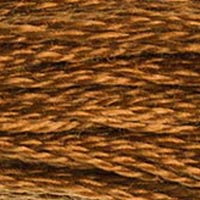
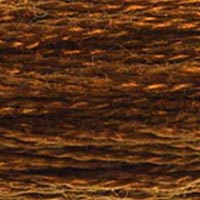
How DMC 975 Looks on Fabric
The same thread appears different depending on your fabric. Always test on your project fabric.
White Aida
Cream / Ecru
Black Aida
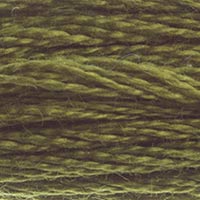
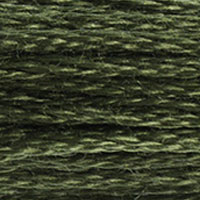
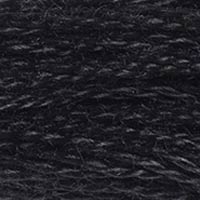
Pairs Well With
DMC colors commonly used alongside 975 Dark Golden Brown.
Suggested Palette
Shading Companions
Detailed Conversions
Where to Buy DMC 975
This section contains affiliate links. We may earn a small commission at no cost to you.
Related Guides
Free Printable Thread Conversion Chart
Pick a brand and download a printable chart mapping all 552 DMC colors to that brand's closest equivalents. Free — no signup needed.
Opens in a new tab. Use your browser's Print → Save as PDF.