
Quick Conversion Table
| Brand | Equivalent | Match |
|---|---|---|
| Anchor | 308 | exact |
| Madeira | 2210 | close |
| Cosmo ⚠ | 705 | close |
| Sullivans | 45200 | close |
| J&P Coats | 5308 | close |
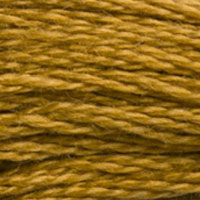
At the dark end of the topaz family, the colors start taking on the quality of things that aren't quite yellow anymore — ancient amber, old honey, beeswax candles, the rich golden-brown of certain wood stains. DMC 782 Dark Topaz occupies this productive middle ground: deep enough to serve as shadow in bright gold designs, golden enough to serve as a primary fill in rich amber-toned designs. It's the color that makes you think of the word "burnished."
The Beeswax and Honey Family
If you've ever stitched a bee or honey-themed design — and given their sustained popularity in cottage-core and nature-inspired cross-stitch communities, there's a good chance you have — DMC 782 has probably appeared in the palette. The amber tones of natural beeswax, raw honeycomb, and dark wildflower honey all live in the deep topaz range. 782 specifically handles the richer, more saturated honey amber that reads as the authentic color of fresh comb honey rather than the lighter processed variety.
Paired with DMC 783 (Medium Topaz) for lighter honey areas and DMC 780 (Ultra Very Dark Topaz) for the deepest shadow areas where honeycomb cells have depth, 782 works as the mid-tone in these designs. Adding DMC 310 (Black) or DMC 3371 (Black Brown) for the bee's black banding completes the palette for most bee-focused designs.
Autumn Wood and Forest Scenes
Forest and autumn landscape cross-stitch frequently relies on the topaz family for its warm golden tones. DMC 782 handles the richly colored autumn light filtering through golden-brown leaves, the warm side of oak bark, and the amber tones of dried grasses in late season landscapes. In a detailed autumn forest scene, 782 provides the saturated gold-brown mid-tone that reads as genuinely warm rather than just brown.
Wood grain patterns — for cabin interiors, rustic furniture, log structures — use 782 for the mid-value wood color that neither reads as a highlight nor as a shadow but as the characteristic warm brown-gold of certain wood species. Oak, cedar, and walnut in their natural finishes have tones in this range that 782 captures with surprising accuracy.
Lion and Wildlife Applications
In the topaz family gradient sequence commonly used for golden wildlife — lions, leopards, golden eagles, certain hawk species, and warm-toned deer — DMC 782 usually occupies the main body fur position. It's lighter than the deep shadow tones of 781 and 780, but richer and more saturated than the bright gold highlights at the top of the range. For a lion's body fur, 782 might cover the majority of the middle tonal zone, with 783 for lit areas, 781 for moderate shadow, and 780 for deep fold shadows.
African safari design themes — elephants, savanna landscapes, golden-hour light effects — regularly incorporate 782 as the warm light coloring that characterizes the light quality on the African plains at sunrise and sunset.
Metallic Gold Imitation
For designs that want to suggest gilded or gold metalwork without actual metallic thread, DMC 782 functions as the mid-value in a gold highlight sequence. The sequence from 783 (brighter gold) through 782 and 781 down to 780 (deepest shadow) creates the sense of curved, reflective gold surfaces — useful for crown motifs, chalice designs, religious iconography, and the kind of decorative metalwork that appears in historical and fantasy cross-stitch patterns. 782's particular warmth gives it a slightly deeper, more antique-gold quality compared to the brighter 783.
Anchor 308 and Madeira 2210 are both exact-rated for DMC 782. The dark topaz range matches well across these brands, and either substitution is reliable for designs where 782 serves as a mid-value or shadow color. Cosmo 705 and Sullivans 45200 are close-rated.
Note that Sullivans 45200 appears in some sources as a match for both DMC 782 and DMC 742 (Light Tangerine) — if you're using a conversion chart that lists the same Sullivans number for both colors, verify the specific shade in hand before using it, as this kind of mapping overlap occurs in some reference charts and can lead to confusion.
Within DMC, the natural emergency substitutes are DMC 781 (Very Dark Topaz) for a slightly darker result and DMC 783 (Medium Topaz) for a slightly lighter, brighter result. The topaz family steps are close enough that a one-step substitution within the family rarely disrupts a design noticeably at viewing distance, though in direct comparison the difference is visible. For honey and amber designs where the specific warm depth of 782 is important, buying the specific skein is worthwhile rather than relying on the adjacent substitutes.
Reference quality
How We Validate This Color Record
Use this page as a reference card for DMC 782: the structured data, quick conversions, and long-form copy are all tied back to the same stored color record.
- Methodology
- This page renders DMC 782, its hex value, and every brand equivalent from the site's source-of-truth color record, then checks long-form body copy against those same stored fields.
- Verification status
- Source-field checked. The page content is audited against the stored DMC number, brand equivalents, and match-quality labels before publishing.
- Last reviewed
- 2026-04-20
- Approximation warning
- Screen hex values, thread photos, and cross-brand conversions are reference aids. Dye lots, thread sheen, and fabric color can still shift the result in hand.
Decision guide
When to use the DMC 782 reference page
This page should help you decide faster between palette planning, brand substitution, and shade comparison without turning the color record into a thin lookup page.
Best for
- + Palette planning when you want the stored DMC 782 Dark Topaz record, hex value #AE7720, and linked brand equivalents in one place.
- + Checking the quickest cross-brand shortlist before you buy floss, compare stash substitutes, or route into a more specific conversion page.
- + Finding nearby shades in the yellows family before you commit to accents, shading, or background blends.
Watch for
- ! Screen previews are only reference aids. Dark Topaz can shift on real fabric because thread sheen, stitch coverage, and room lighting change how the color reads.
- ! A stored equivalent is still a shortlist, not a guarantee that two brands will disappear into each other in the same stitched motif.
- ! Older charts, discontinued kit floss, and dye-lot variation can all introduce small but visible differences that the page cannot detect for you.
Before you commit
- Confirm the role of DMC 782 Dark Topaz: decide whether you need an exact hero shade, a forgiving background, or a rough stash substitute.
- Compare on project fabric: view the skein or stitched sample on the same fabric count and color you will actually use.
- Use the linked conversion pages next: open the brand-specific pages when you need match-quality caveats before substituting away from the DMC reference.
DMC 782 FAQ
These questions appear on the page so the FAQ schema stays aligned with what visitors can actually read.
What is the Anchor equivalent of DMC 782?+
The closest Anchor equivalent to DMC 782 (Dark Topaz) is Anchor 308. This is an exact match.
What color is DMC 782?+
DMC 782 is called "Dark Topaz" and has a hex color value of #AE7720. It belongs to the yellows color family.
What is the Madeira equivalent of DMC 782?+
The closest Madeira equivalent to DMC 782 (Dark Topaz) is Madeira 2210. This is a close match.
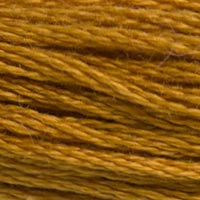
How DMC 782 Looks on Fabric
The same thread appears different depending on your fabric. Always test on your project fabric.
White Aida
Cream / Ecru
Black Aida
Pairs Well With
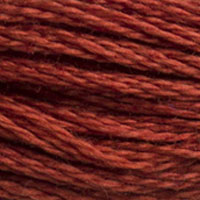
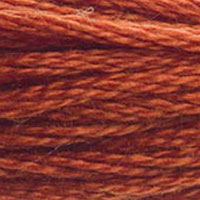
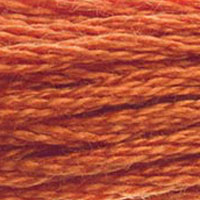
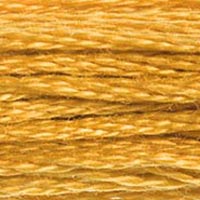
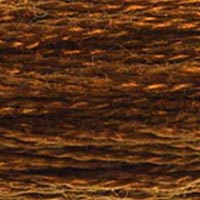
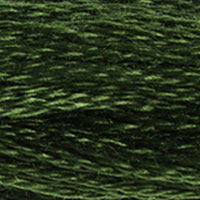
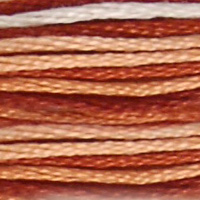
DMC colors commonly used alongside 782 Dark Topaz.

Detailed Conversions
Where to Buy DMC 782
This section contains affiliate links. We may earn a small commission at no cost to you.
Related Guides
Free Printable Thread Conversion Chart
Pick a brand and download a printable chart mapping all 552 DMC colors to that brand's closest equivalents. Free — no signup needed.
Opens in a new tab. Use your browser's Print → Save as PDF.